Artificial Intelligence (AI) is changing how students learn, how doctors interpret medical information, and how healthcare systems operate. For students pursuing MBBS abroad, understanding AI is becoming increasingly important—not because AI will replace doctors, but because future doctors will increasingly work alongside AI-powered technologies.
From virtual patient simulations and personalised learning platforms to medical imaging, clinical decision-support systems and generative AI tools, technology is becoming part of modern medical education.
For students considering MBBS abroad, the key question is no longer simply “Will AI affect medicine?” but “How can I learn to use AI responsibly while developing the clinical skills that only a doctor can provide?”
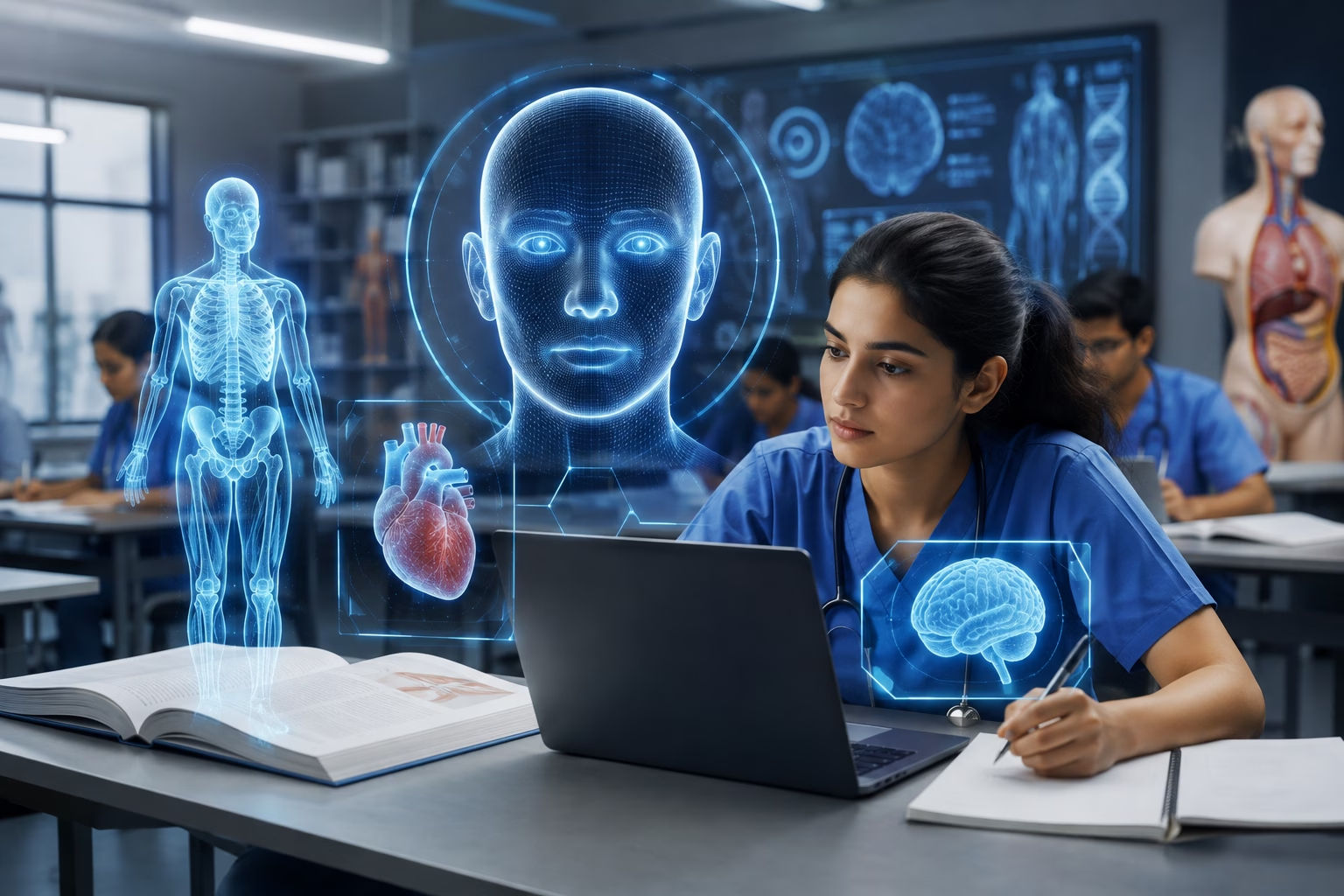
AI is changing medical education by making learning more personalised, interactive and data-driven. MBBS students can use AI for revision, clinical case simulations, medical image learning, research support and personalised study plans. However, AI should complement—not replace—medical textbooks, faculty guidance, clinical exposure and independent clinical reasoning. Students studying medicine abroad should also understand AI ethics, data privacy, bias, hallucinations and responsible use. As healthcare becomes increasingly digital, AI literacy is likely to become an important complementary skill for future doctors.
What Is AI in Medical Education?
AI in medical education refers to the use of artificial intelligence technologies to support the teaching, learning, assessment and clinical training of medical students and healthcare professionals.
AI includes technologies such as:
- Machine learning
- Generative AI
- Natural language processing
- Computer vision
- Predictive analytics
- Virtual patient simulations
- AI-powered tutoring systems
- Medical image analysis
- Automated assessment tools
For an MBBS student, this can mean using an AI-powered learning platform to generate practice questions, simulate patient conversations, explain difficult concepts or help organise revision.
However, AI-generated information should always be verified against authoritative medical resources and guidance from qualified educators.
Research into undergraduate medical education increasingly identifies areas such as AI ethics, theory and application, communication, collaboration and quality improvement as important components of AI education.
How Is AI Changing MBBS Education?
AI is influencing several stages of medical education, from basic science learning to clinical training.
1. Personalised Learning
Traditional medical education generally follows a structured curriculum. AI can add another layer by adapting learning materials to a student’s performance.
For example, an AI learning platform could identify that a student repeatedly struggles with:
- Pharmacology
- Anatomy
- Pathology
- Physiology
- Clinical reasoning
It can then recommend additional explanations, questions or revision material.
This creates a more personalised learning pathway.
2. AI-Powered Medical Tutoring
Generative AI tools can act as supplementary study assistants.
Students can use them to:
- Explain complex medical concepts in simpler language
- Create practice questions
- Generate flashcards
- Compare disease mechanisms
- Summarise notes
- Develop revision schedules
- Practise clinical reasoning scenarios
The important distinction is that AI should be treated as a learning assistant, not as the final authority on medical knowledge.
3. Virtual Patient Simulations
One of the most interesting applications of AI in medical education is simulation.
Students can practise scenarios such as:
A patient presents with chest pain. What questions would you ask first?
AI-powered simulations can allow students to practise history-taking, differential diagnosis and communication before encountering similar situations in real clinical settings.
This can be particularly useful when combined with supervised clinical teaching.
4. Medical Imaging and Diagnostic Learning
AI is increasingly being studied and applied in areas such as:
- Radiology
- Pathology
- Dermatology
- Cardiology
- Surgery
- Ophthalmology
For medical students, AI-assisted image analysis can provide another learning layer when studying X-rays, CT scans, MRI images, pathology slides or other diagnostic material.
However, students should understand that an AI output is not automatically correct. Medical imaging requires clinical context, professional judgement and appropriate validation.
5. AI-Assisted Assessment
AI can also support medical education assessment.
Potential applications include:
- Automated question generation
- Performance analysis
- Adaptive assessments
- Identification of knowledge gaps
- Simulation-based evaluation
- Feedback on learning activities
A 2024 systematic review found that AI tools have been studied for areas including practical skills, disease diagnosis and student performance evaluation, although further rigorous validation is needed.
What Are the Most Useful AI Applications for MBBS Students?
| AI Application | How MBBS Students Can Use It | Main Benefit |
|---|---|---|
| AI Tutor | Ask for concept explanations | Faster understanding |
| Question Generator | Create MCQs and clinical questions | Exam practice |
| Virtual Patients | Practise patient scenarios | Clinical reasoning |
| Medical Image Tools | Study diagnostic images | Visual learning |
| Research Assistance | Organise literature and ideas | Research efficiency |
| Flashcard Generation | Create revision cards | Active recall |
| Study Planning | Build revision schedules | Better organisation |
| Language Assistance | Improve understanding of medical terminology | Communication support |
| Simulation Platforms | Practise clinical situations | Practical preparation |
| Data Analysis Tools | Understand research datasets | Research skills |
The effectiveness of these applications depends on how they are implemented. A systematic review of global undergraduate medical curricula found that AI performed best as a supplement to existing medical education, rather than as a replacement for human teaching.
Why Is AI Important for Students Studying MBBS Abroad?
Students studying medicine abroad may encounter different healthcare systems, teaching methodologies, technologies and clinical environments.
AI literacy can therefore become an additional professional skill.
AI Can Support Students Across Different Learning Environments
An MBBS abroad student may use digital learning platforms for:
- Pre-clinical subjects
- Anatomy learning
- Clinical case discussions
- Exam preparation
- Research
- Simulation
- Clinical documentation training
The exact technologies available will depend on the university and country.
Students should therefore evaluate the actual curriculum, clinical exposure, university facilities and accreditation requirements rather than choosing a medical university simply because it advertises advanced technology.
Can AI Replace Medical Teachers?
No. AI should not replace medical educators.
Medical education involves much more than memorising information.
Doctors need to develop:
- Clinical reasoning
- Communication
- Empathy
- Physical examination skills
- Ethical judgement
- Teamwork
- Decision-making under uncertainty
- Professional responsibility
- Patient-centred care
AI can assist with information and simulation, but it cannot substitute for supervised clinical experience and the doctor-patient relationship.
What Are the Benefits of AI in Medical Education?
1. Personalised Study Support
AI can help students identify areas where they need additional practice.
2. Faster Access to Explanations
Students can request explanations at different levels of complexity.
3. More Interactive Learning
Case simulations and conversational tools can make learning more engaging.
4. Additional Practice
Students can generate unlimited practice questions and hypothetical cases.
5. Support for Research
AI can assist with tasks such as organising information, brainstorming research questions and analysing certain types of data.
6. Clinical Simulation
AI-powered virtual patients can provide opportunities to practise decision-making in a controlled environment.
7. Preparation for Digital Healthcare
AI literacy can help students understand the technologies they may encounter during future clinical practice.
Recent research continues to show interest among medical students in AI education. A 2026 systematic review and meta-analysis involving more than 20,000 medical students found strong support for integrating AI into undergraduate medical education, while also identifying a gap between students’ belief that AI training is necessary and their confidence in applying AI clinically.
What Are the Risks of Using AI in Medical Education?
AI offers significant opportunities, but medical students need to understand its limitations.
AI Hallucinations
Generative AI can produce information that sounds convincing but is incorrect.
For medical students, this is particularly important because inaccurate information can affect understanding of diseases, drugs, diagnosis and treatment.
Always verify important medical information.
Bias
AI systems can reproduce biases present in their training data.
WHO highlights bias, equity, privacy and governance as important considerations in AI for health.
Overdependence
If students rely on AI for every answer, they may practise less independent reasoning.
A 2026 systematic review examining AI-supported learning found evidence of improved efficiency and basic knowledge acquisition, but results were less consistent for higher-order clinical reasoning.
Data Privacy
Students should never enter confidential patient information into consumer AI platforms unless the platform and institutional policy explicitly permit that use.
Academic Integrity
Using AI to generate assignments, examinations or research work without following university rules can create academic-integrity problems.
AI Tools vs Traditional Medical Education: Which Is Better?
The better approach is integration rather than replacement.
| Traditional Medical Education | AI-Supported Education |
| Faculty-led teaching | AI-assisted explanations |
| Textbooks and journals | AI-assisted information discovery |
| Classroom discussion | Interactive AI practice |
| Clinical rotations | Virtual clinical simulations |
| Written examinations | Adaptive assessments |
| Human feedback | Automated supplementary feedback |
| Direct patient interaction | Virtual patient scenarios |
| Faculty mentorship | AI-powered study assistance |
The strongest model combines both.
Human teaching + clinical experience + evidence-based resources + responsible AI = future-ready medical education.
What AI Skills Should Future Doctors Learn?
Students do not necessarily need to become AI engineers.
Instead, medical students should develop AI literacy.
Important skills include:
1. Understanding AI Basics
Know the difference between:
- AI
- Machine learning
- Deep learning
- Generative AI
- Large language models
- Computer vision
2. Evaluating AI Outputs
Ask:
- Is the information accurate?
- What is the source?
- Is the information current?
- Could the model be biased?
- Does the answer require professional verification?
3. Prompting and Communication
Students can learn how to structure clear prompts to obtain useful educational outputs.
4. Data Privacy
Understand what patient and personal information should never be entered into an AI system.
5. AI Ethics
Understand:
- Bias
- Accountability
- Transparency
- Privacy
- Consent
- Human oversight
6. Clinical Reasoning
Perhaps most importantly, students must continue developing independent clinical reasoning rather than simply accepting AI-generated answers.
UNESCO’s guidance on generative AI in education also emphasises a human-centred approach, data privacy and ethical validation of AI tools.
How Should MBBS Abroad Students Use AI Responsibly?
A simple VERIFY framework can help.
V — Verify
Check important information using reliable medical resources.
E — Evaluate
Assess whether the AI response makes clinical and scientific sense.
R — Reference
Use textbooks, peer-reviewed research and institutional resources for authoritative information.
I — Identify Limitations
Remember that AI can make mistakes, omit context or generate outdated information.
F — Follow University Policies
Check your university’s rules regarding AI use in assignments, research and assessments.
Y — Your Clinical Judgement Matters
Use AI to support learning—not to replace independent reasoning or professional supervision.
What Does the Future of AI in Medical Education Look Like?
The future is likely to involve AI-assisted rather than AI-only medical education.
Potential developments include:
- Personalised AI tutors
- Advanced virtual patients
- AI-powered anatomy platforms
- Immersive simulation
- Automated formative feedback
- AI-assisted medical research
- Intelligent clinical simulations
- Personalised revision systems
- AI-supported diagnostic education
- Multimodal learning using text, images and video
Research published in 2026 continues to highlight the potential of generative AI-assisted teaching in medical education, while reinforcing the need for appropriate implementation and evaluation.
At the same time, the medical profession will continue to require human capabilities that technology cannot simply automate.
Should AI Be a Factor When Choosing an MBBS Abroad University?
Yes—but it should not be the only factor.
When comparing universities, students should evaluate:
- University recognition and accreditation
- Curriculum structure
- Clinical exposure
- Teaching hospitals
- Faculty expertise
- Laboratory and simulation facilities
- Student support
- Internship opportunities
- Total tuition and living costs
- Accommodation
- Licensing and eligibility requirements
- Country-specific regulations
- Opportunities for research
- Digital learning infrastructure
For Indian students, regulatory and eligibility requirements should be checked carefully using the latest official information from the relevant authorities.
The National Medical Commission publishes information on India’s undergraduate medical curriculum and competency-based medical education.
Common Mistakes MBBS Students Make When Using AI
Mistake 1: Treating AI as a Medical Textbook
AI-generated answers can contain errors.
Better approach: Cross-check important information.
Mistake 2: Using AI for Every Assignment
This can reduce independent learning and may violate university policies.
Better approach: Use AI primarily for explanation, brainstorming and practice where permitted.
Mistake 3: Entering Patient Information
Never share identifiable patient information with an AI platform without appropriate authorisation.
Mistake 4: Ignoring Clinical Experience
Virtual cases cannot replace real patients and supervised clinical training.
Mistake 5: Choosing a University Based Only on Technology
An impressive AI platform does not compensate for weak clinical exposure or poor academic infrastructure.
Mistake 6: Assuming AI Always Gives Current Information
AI systems can have knowledge limitations or produce outdated information.
Expert Tips for MBBS Abroad Students
Tip 1: Use AI to explain difficult concepts, then verify them using standard medical resources.
Tip 2: Ask AI to generate clinical cases and try solving them independently before viewing the suggested answer.
Tip 3: Use AI to identify your weak topics and create revision plans.
Tip 4: Never use AI as the sole basis for clinical decisions.
Tip 5: Learn AI ethics and data privacy alongside technical skills.
Tip 6: Check your university’s AI policy before using AI for assignments or examinations.
Tip 7: Build strong fundamentals in anatomy, physiology, pathology, pharmacology and clinical reasoning. AI works best when the learner already has a strong knowledge base.
What Does AI Mean for the Future of Medical Careers?
AI is likely to change how doctors work, rather than simply eliminate the need for doctors.
Future healthcare professionals may increasingly work with:
- Clinical decision-support systems
- AI-assisted diagnostics
- Digital patient records
- Predictive analytics
- Remote monitoring
- Medical robotics
- Personalised medicine
- AI-supported research
This means future doctors may need a combination of medical knowledge, clinical judgement, communication skills and digital literacy.
For MBBS abroad students, developing these skills during medical school can help them adapt to an increasingly technology-enabled healthcare environment.
AI in Medical Education: Key Takeaways
- AI is becoming an important component of modern medical education.
- MBBS students can use AI for personalised learning, revision, simulation and research support.
- AI should supplement textbooks, faculty teaching and clinical exposure.
- Medical students must learn to identify AI errors and potential bias.
- Patient privacy and academic integrity are critical.
- Clinical reasoning should not be outsourced to AI.
- AI literacy can become a valuable complementary skill for future doctors.
- When choosing an MBBS abroad university, technology should be considered alongside accreditation, curriculum, clinical exposure and student support.
- The future of medical education is likely to be human-led and AI-assisted.
Is AI the Future of Medical Education?
AI is already becoming part of the future of medical education—but it is not the future by itself.
The strongest medical education model will combine technology with experienced educators, evidence-based medicine, clinical exposure and human-centred healthcare.
For students planning to study MBBS abroad, learning how to work with AI rather than blindly relying on AI can become an important professional advantage.
The future doctor may not be the person who knows the most about technology. It may be the doctor who knows when to use technology, when to question it, and when human judgement must come first.
Planning to Study MBBS Abroad?
Choosing the right country and university requires more than comparing tuition fees. Students and parents need to understand eligibility, university recognition, admission procedures, clinical exposure, total costs and future career considerations.
SquareOne Overseas can help you understand your MBBS abroad options and make an informed decision based on your academic profile and career goals.
Get expert MBBS Abroad counselling from SquareOne Overseas today.