MBBS IN RUSSIA
Why Study MBBS in Russia? Top Reasons for Indian Students
MBBS in Russia for Indian students has grown immensely popular — and for good reason. Russia offers some of the best medical universities in Russia for Indian students with globally recognised degrees, cutting-edge infrastructure, and clinical exposure that matches world-class standards. Here’s why thousands of Indian families choose MBBS abroad in Russia every year:

Best & Top NMC Approved Medical Universities in Russia
Selecting the right institution is the most critical step when you apply for MBBS in Russia. Below is a curated list of the top medical universities in Russia for MBBS that are NMC approved, WHO listed, and highly popular among Indian students.
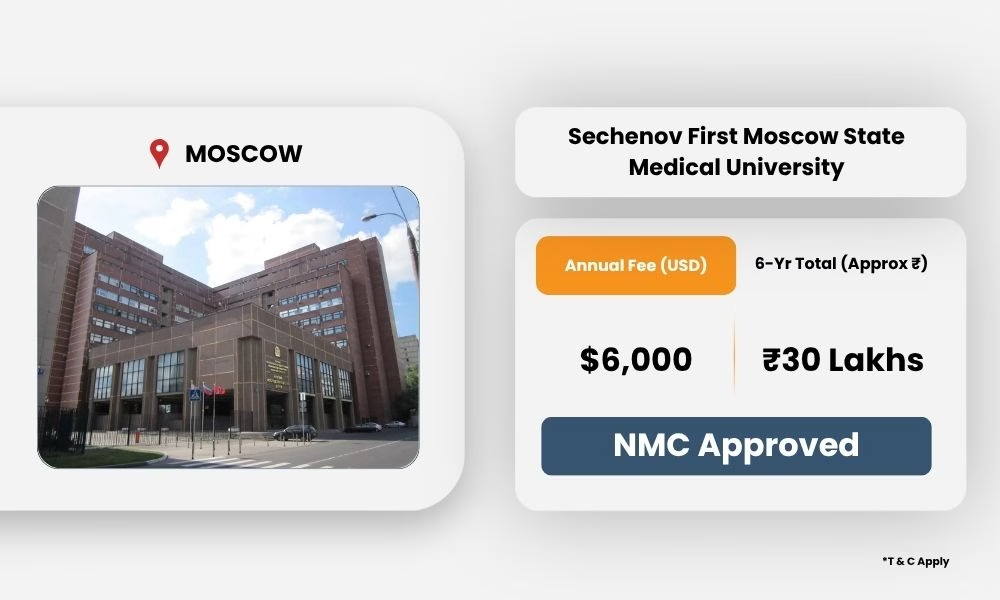
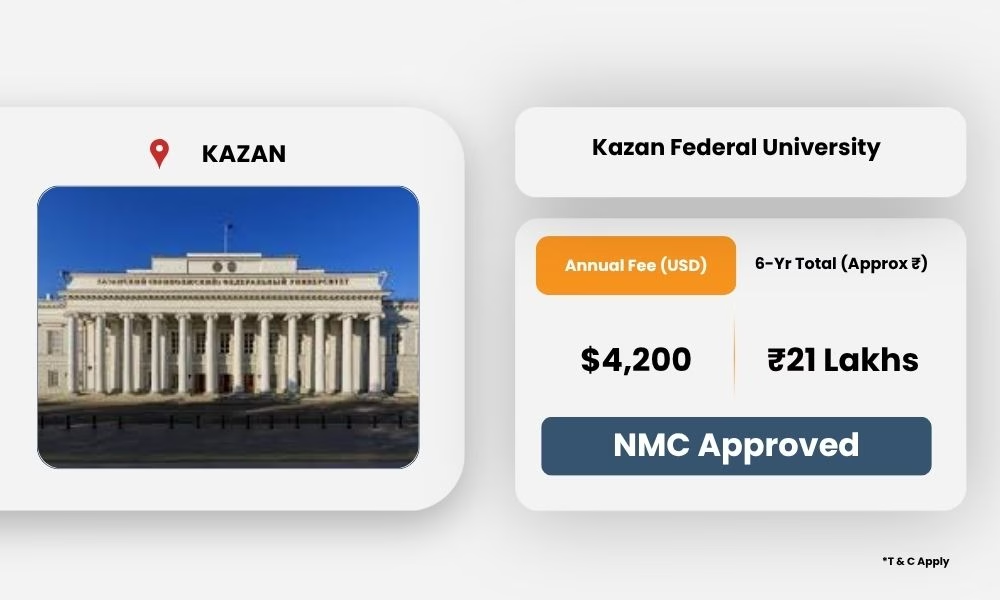
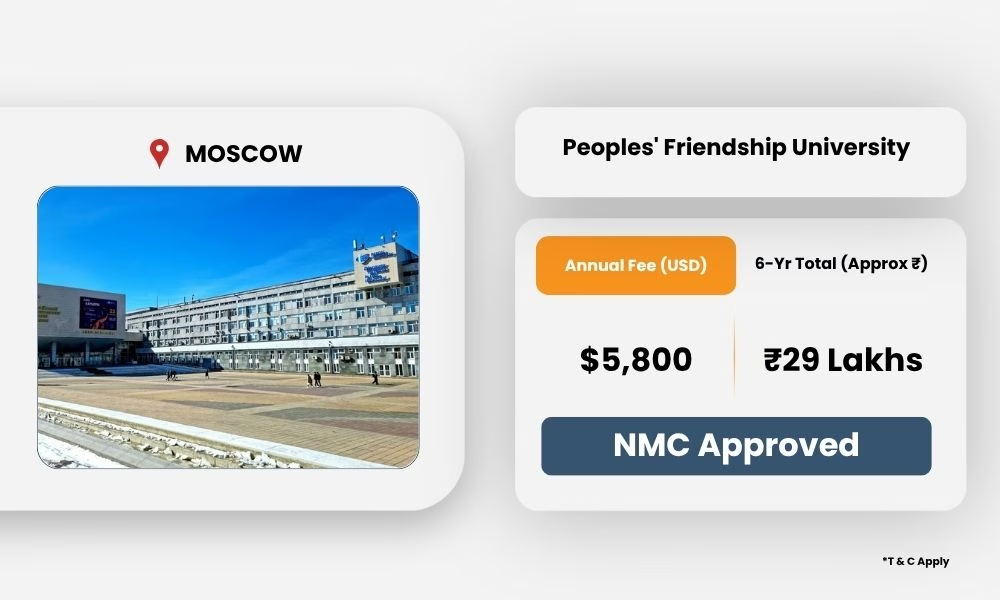
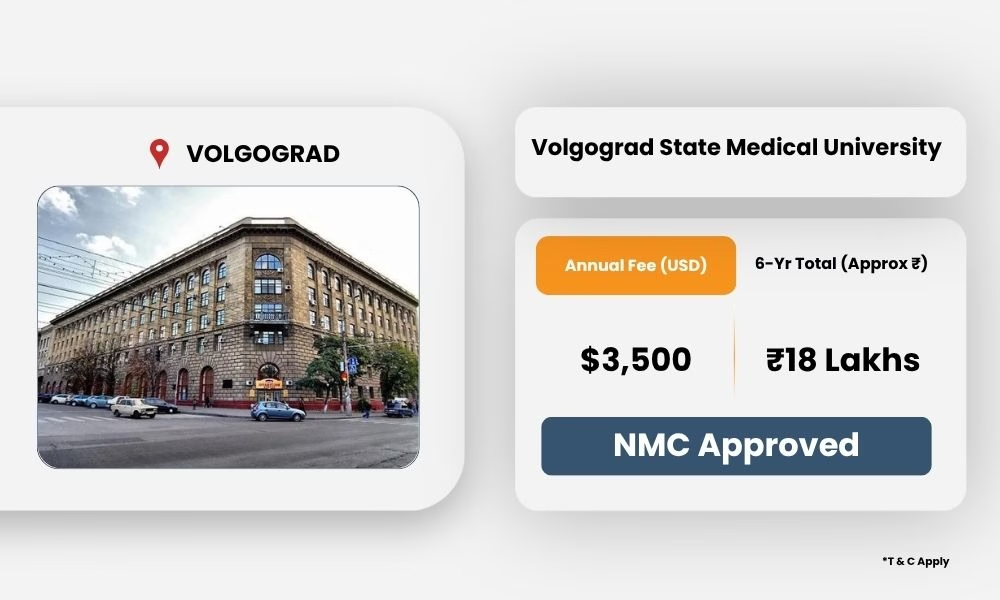
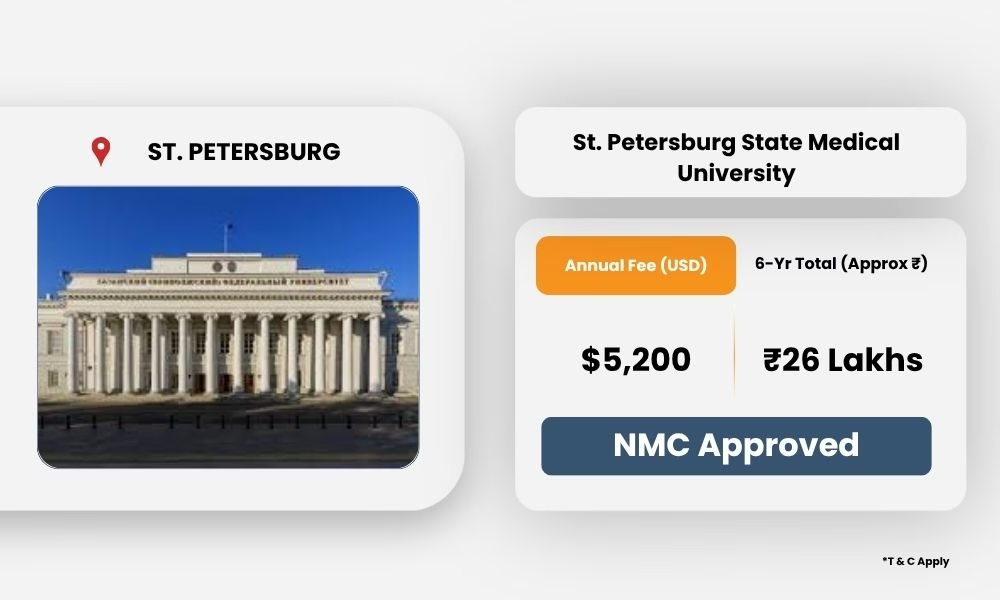
RUSSIA MBBS UNIVERSITY FEE LIST
ACADEMIC YEAR 2026–2027
| S.NO. | University | City Name | Annual Tuition(Approx.) |
|---|---|---|---|
| 1 | Irkutsk State Medical University | Irkutsk Oblast | ₹380,000 |
| 2 | Kemerovo State University | Kemerovo Oblast | ₹299,000 |
| 3 | Omsk State Medical University | Omsk Oblast | ₹370,000 |
| 4 | North Ossetian State Medical Academy | Vladikavkaz | ₹360,000 |
| 5 | Tambov State University | Tambov | ₹410,000 |
| 6 | Far Eastern Federal University | Vladivostok | ₹500,000 |
| 7 | Kazan Federal University | Kazan | ₹660,000 |
| 8 | Yelets State University | Yelets | ₹325,000 |
| 9 | Kazan State Medical University | Kazan | ₹600,000 |
| 10 | Bashkir State Medical University | Ufa | ₹405,000 |
| 11 | Immanuel Kant Baltic Federal University | Kaliningrad | ₹347,380 |
| 12 | Tver State Medical University | Tver Oblast | ₹430,000 |
| 13 | North-Western State Medical University | Saint Petersburg | ₹550,000 |
| 14 | Samara State Medical University | Samara Oblast | ₹450,000 |
| 15 | Ural State Medical University | Yekaterinburg | ₹360,000 |
| 16 | Kabardino-Balkarian State University | Nalchik | ₹324,000 |
| 17 | Northern State Medical University | Arkhangelsk | ₹350,000 |
| 18 | MEPHI National Research Nuclear University (Obninsk) | Obninsk | ₹510,000 |
| 19 | Privolzhsky Research Medical University | Nizhny Novgorod | ₹380,000 |
| 20 | Ulyanovsk State Medical UniversityUpdated Fee 2026 | Ulyanovsk | ₹352,000 |
| 21 | Yaroslavl State Medical UniversityUpdated Fee 2026 | Yaroslavl | ₹395,000 |
| 22 | Kirov State Medical UniversityUpdated Fee 2026 | Kirov | ₹365,000 |
| 23 | Chita State Medical UniversityUpdated Fee 2026 | Chita | ₹320,000 |
| 24 | North-Caucasus Federal UniversityUpdated Fee 2026 | Stavropol | ₹320,000 |
| 25 | North-Western State Medical UniversityUpdated Fee 2026 | Saint Petersburg | ₹550,000 |
| 26 | Saint Petersburg State University of Veterinary MedicineUpdated Fee 2026 | Saint Petersburg | ₹450,000 |
| 27 | Privolzhsky Research Medical UniversityUpdated Fee 2026 | Nizhny Novgorod | ₹530,000 |
| 28 | Volgograd State Medical UniversityUpdated Fee 2026 | Volgograd | ₹505,000 |
| 29 | Syktyvkar State UniversityUpdated Fee 2026 | Syktyvkar | ₹300,350 |
| 30 | MEPhI National Research Nuclear University MoscowUpdated Fee 2026 | Moscow | ₹580,000 |
| 31 | Kuban State Medical UniversityUpdated Fee 2026 | Krasnodar | ₹390,000 |
| 32 | Sevastopol State UniversityUpdated Fee 2026 | Sevastopol | ₹287,500 |
| 33 | Kabardino Balkarian State Medical UniversityUpdated Fee 2026 | Nalchik | ₹324,000 |
| 34 | Tambov State Medical UniversityUpdated Fee 2026 | Tambov | ₹410,000 |
| 35 | Synergy UniversityUpdated Fee 2026 | Moscow | ₹280,000 |
| 36 | St. Petersburg State Pediatric Medical UniversityUpdated Fee 2026 | Saint Petersburg | ₹490,000 |
Please note: Tuition fees are approximate and may be revised annually.
MBBS in Russia Admission Process — Step by Step for Indian Students
The admission process for MBBS in Russia is straightforward when guided by experts. Here is how Indian students can apply for MBBS in Russia directly without any hassle:
Choose the Right NMC Approved University in Russia
Shortlist the best university for MBBS in Russia based on your NEET score, budget, city preference, and FMGE pass record. Our free counselling session helps you pick the perfect match.
Submit Application & Documents Online
Fill out the university application form and submit documents including your NEET scorecard, 10+2 marksheets, and passport. Applications for MBBS Russia intake are open now.
Receive Official Invitation Letter
After document verification, the university issues a formal invitation letter — the key document required to apply for a Russian student visa for MBBS. Processing takes 2–4 weeks.
Apply for Russian Student Visa
Submit your student visa application for MBBS in Russia at the Russian Embassy/Consulate in India. We provide complete visa assistance for MBBS in Russia — documentation, checklist, and appointment support.
Travel to Russia & University Registration
Fly to Russia and complete airport pickup, hostel check-in, and university registration. Our on-ground team in Russia assists with initial settlement, SIM card, and bank account setup.
Begin Your 6-Year MBBS / MD Program
Start your 6-year MBBS program in Russia with English-medium lectures. Clinical rotations begin from year 3. FMGE/NEXT coaching is integrated from year 1 at select universities.
MBBS in Russia Fees for Indian Students
Complete Fee Breakdown — Transparent & Affordable Medical Education
Annual Cost Breakdown (Per Year)
- 💰 Tuition Fee: $3,500 – $6,000/year
- 🏠 Hostel / Accommodation: $600 – $1,200/year
- 🍽️ Food & Living Expenses: $1,500 – $2,400/year
- ✈️ Travel (India ↔ Russia): ₹60,000 – ₹90,000/year
- 🛡️ Medical Insurance: ~$200/year
- 📄 One-Time Visa & Processing: ₹25,000 – ₹40,000
Total MBBS Cost in Russia (6 Years)
- 🎓 Budget University: ₹18 – ₹22 Lakhs
- 🏫 Mid-Range University: ₹23 – ₹27 Lakhs
- ⭐ Premium University: ₹28 – ₹35 Lakhs
- 🇮🇳 vs India Private College: ₹60 – ₹1.2 Crore
- 🚫 No Donation / No Capitation Fee
- 🏦 Education Loan Available via Indian Banks
MBBS in Russia Eligibility
Simple Requirements. Easy Admission Process for Indian Students
🎓 Academic Qualification
10+2 with PCB (Physics, Chemistry & Biology) & minimum 50% (45% for reserved categories). Recognised board required.
📝 NEET Qualification
NEET is mandatory as per NMC. Only qualifying marks required.
🎂 Age Criteria
Minimum 17 years before Dec 31. No upper age limit.
📄 Documents Required
- 10th & 12th Marksheets
- NEET Scorecard
- Passport (3+ Years Valid)
- Passport Size Photos
- Medical Fitness Certificate
- Affidavit of Genuineness
FMGE / NEXT Exam After MBBS in Russia — What You Need to Know
After completing your MBBS from Russia, Indian students must clear the FMGE (Foreign Medical Graduate Exam) — now being replaced by NEXT (National Exit Test) — to practice medicine in India. Here is what you should know about the FMGE pass rate for Russia MBBS graduates:
FMGE / NEXT Key Facts
- Conducted by: National Board of Examinations (NBE)
- Eligibility: Graduate from WHO/NMC approved foreign university
- Subjects: 19 medical subjects, 300 MCQs
- Passing marks: 150/300 (50%)
- Attempts: Unlimited until cleared
- Top Russia FMGE passers: Sechenov, RUDN, Kazan
How to Improve FMGE Pass Rate
- Choose a university with integrated FMGE coaching
- Start FMGE preparation from year 1 of MBBS
- Attend regular mock tests & revision sessions
- Join India-based FMGE crash courses before return
- Prefer universities with higher clinical exposure
- Connect with FMGE-cleared alumni from your university
GOZZ and Accreditation Exams in Russia
A practical guide for Indian MBBS students and parents on the final university examination (GOZZ) and the Russian medical licensing/accreditation examination.
1. Overview
After completing an MBBS/MD-Physician programme in Russia, a student normally completes two important assessments: the GOZZ (State Final Examination) and the Primary Accreditation Examination. The GOZZ is primarily the final university examination required for the award of the medical degree, while the accreditation examination is the national licensing assessment required to practise medicine in Russia. Important distinction: GOZZ generally leads to the degree; Accreditation generally leads to the licence to practise in Russia. These are not the same examination.
2. What is GOZZ?
GOZZ, also written as GOSS, refers to the Russian State Final Examination (Gosudarstvennaya itogovaya attestatsiya). It is conducted at the end of the final year of the medical programme and assesses theoretical knowledge, clinical reasoning, practical skills and readiness for independent medical practice. The examination is generally organised by the student’s university. Depending on the university and programme, it may be conducted in English, Russian, or a combination of both. Students should confirm the exact language and format with their own university, as procedures can vary.
3. GOZZ Examination Structure
| Stage | Assessment Type | What Is Evaluated |
|---|---|---|
| Stage 1 | Written / Computer-based Test | MCQs and clinical knowledge across major medical subjects. |
| Stage 2 | Practical / Clinical Skills Test | Patient history, examination findings, investigation reports, diagnosis and management plan. |
| Stage 3 | Oral Examination / Viva Voce | Clinical reasoning, subject knowledge, communication and case discussion with examiners. |
4. Subjects Commonly Covered in GOZZ
- Anatomy, Physiology and Biochemistry
- Pathology, Pathophysiology and Pharmacology
- Microbiology and Immunology
- Internal Medicine
- Surgery
- Obstetrics and Gynaecology
- Paediatrics
- Public Health, Epidemiology and Medical Ethics
- Emergency Medicine and Clinical Skills
5. Outcome of GOZZ
A student who successfully completes GOZZ and all other university requirements receives the Russian medical degree, generally titled MD Physician. This degree is commonly considered equivalent to MBBS for Indian students. Students with outstanding academic performance may receive a “Red Diploma”, an academic distinction awarded by some universities. Passing GOZZ alone does not automatically permit a graduate to practise as a doctor in Russia. For professional practice in Russia, the graduate must complete the Primary Accreditation Examination.
6. What is the Accreditation Examination?
The Primary Accreditation Examination, often called the Russian licensing or accreditation examination, is the national assessment required for medical graduates who wish to obtain permission to practise medicine in Russia. It evaluates whether the graduate meets the professional standards required by the Russian healthcare system. For Indian students, this examination has become especially important because Indian regulatory requirements generally require foreign medical graduates to obtain a licence to practise in the country where they studied, subject to the prevailing NMC rules and documentation requirements.
7. Accreditation Examination Structure
| Component | Format | Purpose |
|---|---|---|
| Theoretical / Online Test | Computer-based MCQ test | Tests core medical knowledge and clinical decision-making. |
| Clinical Skills Test | Hospital or simulation-based assessment | Tests history taking, examination, diagnosis, investigations and treatment planning. |
| Case-based / Online Clinical Assessment | Case scenarios or structured questions | Tests applied clinical reasoning and management of patient cases. |
8. Language Requirement
The accreditation examination is generally conducted in Russian because a doctor practising in Russia must be able to communicate safely with Russian-speaking patients, colleagues and healthcare authorities. The practical and case-based components may require reading clinical information, explaining a diagnosis and communicating a management plan in Russian. Therefore, students in English-medium MBBS programmes should still learn Russian medical terminology, clinical communication and basic patient-interaction skills throughout the course. Many universities provide Russian-language and medical-terminology support for international students.
9. GOZZ vs Accreditation Examination
| Point | GOZZ Examination | Accreditation Examination |
|---|---|---|
| Main purpose | Final university examination for the medical degree | National licensing examination for practice in Russia |
| Conducting body | Usually the university | Russian accreditation/licensing authority under the national system |
| Timing | Final year / end of MBBS programme | After completing the degree and meeting eligibility requirements |
| Language | May be English or Russian, depending on university | Generally Russian |
| Outcome | MD Physician / medical degree | Licence or accreditation to practise medicine in Russia |
| Assessment | MCQ, practical and viva | Theory test, clinical skills and case-based assessment |
| Importance for India | Required for degree completion | Important for NMC/FMGE-related licensing documentation, subject to current NMC rules |
10. Preparation Strategy
- Revise all major pre-clinical, para-clinical and clinical subjects systematically.
- Practise MCQs, clinical vignettes, case discussions and previous assessment questions.
- Strengthen history taking, physical examination, diagnosis, investigations and treatment planning.
- Attend clinical rotations, hospital postings, simulation sessions and skills labs seriously.
- Learn Russian medical terminology, especially symptoms, examinations, diagnoses, investigations and treatment instructions.
- Practise speaking about common clinical cases in Russian for viva and accreditation preparation.
- Use university-provided question banks, mock tests and faculty guidance.
- Keep all academic records, passport, visa documents and university communications safely organised.
11. After Accreditation: India Pathway
After completing MBBS in Russia, Indian students who wish to practise in India must follow the applicable National Medical Commission (NMC) requirements. This usually includes obtaining the required licence/registration evidence from Russia and then qualifying through the prescribed Indian screening or licensing examination, such as FMGE/NExT, as applicable at the time of graduation. Students should verify the latest NMC regulations, university recognition status, course duration, internship requirements and documentation rules before admission and again before graduation, because regulations can change.
12. Key Takeaways for Students and Parents
- GOZZ is the final university examination required for the medical degree.
- Accreditation is the licensing examination required to practise medicine in Russia.
- The accreditation examination is generally conducted in Russian.
- Russian language and clinical communication skills are important from the first year onward.
- Choosing a university with strong clinical training, English-medium teaching and Russian-language support is essential.
- Indian students must also plan for FMGE/NExT and comply with current NMC regulations.
13. Disclaimer
This document is for general guidance only. Examination patterns, language, eligibility, passing criteria, licensing procedures and NMC requirements may change. Students and parents should confirm the latest requirements directly with the respective Russian university, the Russian licensing authority and the National Medical Commission, India.
Russia Medical Universities – FMGE Session-wise Results
Sessions requested: June 2025, December 2025
| S.No. | Medical University / Institute | June 2025 Appeared |
June 2025 Passed |
June 2025 Pass % |
Dec 2025 Appeared |
Dec 2025 Passed |
Dec 2025 Pass % |
|---|---|---|---|---|---|---|---|
| 1 | Mari State University Medical Faculty | 365 | 72 | 19.73% | 639 | 216 | 33.80% |
| 2 | Perm State Medical University Named After Academician E. A. Wagner | 353 | 70 | 19.83% | 473 | 131 | 27.70% |
| 3 | Northern State Medical University | 328 | 56 | 17.07% | 471 | 116 | 24.63% |
| 4 | Smolensk State Medical University | 249 | 55 | 22.09% | 430 | 186 | 43.26% |
| 5 | Stavropol State Medical University | 321 | 27 | 8.41% | 401 | 60 | 14.96% |
| 6 | Orenburg State Medical University | 158 | 40 | 25.32% | 309 | 140 | 45.31% |
| 7 | Ulyanovsk State University Medical Faculty Named After T. Z. Biktimirov | 164 | 30 | 18.29% | 277 | 81 | 29.24% |
| 8 | National Research Ogarev Mordovia State University Medical Faculty | 102 | 22 | 21.57% | 277 | 120 | 43.32% |
| 9 | Crimean Federal University Named After V. I. Vernadsky | 93 | 19 | 20.43% | 275 | 168 | 61.09% |
| 10 | Kabardino-Balkarian State University Faculty of Medicine | 190 | 38 | 20.00% | 268 | 85 | 31.72% |
| 11 | Kursk State Medical University | 247 | 50 | 20.24% | 264 | 66 | 25.00% |
| 12 | Volgograd State Medical University | 228 | 26 | 11.40% | 239 | 40 | 16.74% |
| 13 | Kazan State Medical University | 159 | 34 | 21.38% | 228 | 73 | 32.02% |
| 14 | Penza State University Medical Institute | 97 | 27 | 27.84% | 169 | 58 | 34.32% |
| 15 | Bashkir State Medical University | 128 | 28 | 21.88% | 168 | 42 | 25.00% |
| 16 | Tver State Medical University | 180 | 20 | 11.11% | 157 | 12 | 7.64% |
| 17 | Medical Institute of Tambov State University Named After G. R. Derzhavin | 100 | 20 | 20.00% | 145 | 52 | 35.86% |
| 18 | Far Eastern Federal University School of Biomedicine | 46 | 10 | 21.74% | 143 | 54 | 37.76% |
| 19 | North Ossetian State Medical Academy | 87 | 17 | 19.54% | 139 | 33 | 23.74% |
| 20 | Altai State Medical University | 107 | 19 | 17.76% | 133 | 33 | 24.81% |
| 21 | Privolzhsky Research Medical University | 81 | 19 | 23.46% | 120 | 45 | 37.50% |
| 22 | North Caucasian State Humanitarian Technological Academy | 71 | 17 | 23.94% | 108 | 23 | 21.30% |
| 23 | Rostov State Medical University | 49 | 5 | 10.20% | 106 | 36 | 33.96% |
| 24 | Orel State University Medical Institute | 72 | 12 | 16.67% | 86 | 18 | 20.93% |
| 25 | Voronezh State Medical University Named After N. N. Burdenko | 89 | 13 | 14.61% | 77 | 16 | 20.78% |
| 26 | Chuvash State University Medical Institute | 38 | 8 | 21.05% | 66 | 25 | 37.88% |
| 27 | Kemerovo State Medical University | 39 | 9 | 23.08% | 65 | 20 | 30.77% |
| 28 | Dagestan State Medical University | 52 | 6 | 11.54% | 63 | 6 | 9.52% |
| 29 | Kuban State Medical University | 27 | 3 | 11.11% | 57 | 23 | 40.35% |
| 30 | Siberian State Medical University | 26 | 4 | 15.38% | 52 | 22 | 42.31% |
| 31 | Immanuel Kant Baltic Federal University Institute of Medicine | 19 | 10 | 52.63% | 45 | 24 | 53.33% |
| 32 | Belgorod National Research University Medical Institute | 41 | 1 | 2.44% | 43 | 2 | 4.65% |
| 33 | Irkutsk State Medical University | 17 | 2 | 11.76% | 40 | 11 | 27.50% |
| 34 | First Moscow State Medical University Named After I. M. Sechenov | 27 | 2 | 7.41% | 32 | 6 | 18.75% |
| 35 | North-Western State Medical University I. I. Mechnikov | 24 | 0 | 0.00% | 32 | 1 | 3.13% |
| 36 | Ivanovo State Medical Academy | 18 | 1 | 5.56% | 30 | 7 | 23.33% |
| 37 | Saratov State Medical University Named After V. I. Razumovsky | 29 | 3 | 10.34% | 28 | 5 | 17.86% |
| 38 | Kazan Federal University Institute of Fundamental Medicine and Biology | 5 | 2 | 40.00% | 24 | 21 | 87.50% |
| 39 | Obninsk Institute of Atomic Energy, National Nuclear Research University MEPhI Medical Faculty | 6 | 1 | 16.67% | 24 | 8 | 33.33% |
| 40 | Astrakhan State Medical University | 17 | 4 | 23.53% | 20 | 3 | 15.00% |
QUESTIONS / ANSWERS
Frequently asked questions
Russia is one of the destinations Indian students consider for medical education. Russian medical universities offer structured medical programmes, experienced faculty, laboratory facilities and clinical training opportunities. Students should compare each university's curriculum, clinical exposure, language of instruction and eligibility before applying.
Indian students who wish to pursue medical education abroad and later practise in India must qualify for, NEET as per the applicable NMC requirements. Students should check their eligibility before taking admission.
IELTS or TOEFL is not a universal requirement for admission to Russian medical universities. Requirements vary depending on the university and its admission policy. Students should confirm the language requirements before applying.
Admissions generally take place around the academic year commencement, but application dates differ between universities. Students should check the official admission calendar and available seats for their preferred intake.
Commonly required documents include Class 10 and Class 12 marksheets and certificates, NEET scorecard, valid passport-size photographs, medical fitness certificate and any other documents requested by the university.
Some Russian universities conduct entrance examinations in subjects such as Biology and Chemistry. The admission process differs between universities, so students should verify the requirements before applying
Many Russian medical universities provide hostel accommodation for international students. Facilities, room-sharing arrangements, availability and charges differ by university.
Indian students can find Indian restaurants and grocery stores in several Russian cities. Some university hostels also provide kitchen facilities where students can prepare their own meals.
Foreign medical graduates must fulfil the applicable Indian licensing requirements. FMGE has historically been the screening examination for eligible foreign medical graduates. Students should check the latest NMC and NBEMS notifications regarding the applicable examination pathway at the time of graduation
Students may travel to India during permitted university holidays, subject to university attendance rules, visa conditions and immigration requirements. They must ensure that travel does not affect their academic schedule or mandatory clinical training.