MBBS in Vietnam
Why Study MBBS in Vietnam? Top Reasons for Indian Students
MBBS in Vietnam for Indian students is an emerging and exciting opportunity that combines quality medical education with one of Asia’s most affordable living costs. Vietnam is quickly establishing itself among the best medical universities in Vietnam for Indian students — offering internationally recognised degrees, strong clinical exposure in top-tier hospitals, and a modern, research-driven curriculum. Here is why MBBS abroad in Vietnam is winning the attention of thousands of Indian families.

NMC & WHO Approved Universities in Vietnam
All recommended NMC approved universities in Vietnam are listed in the World Directory of Medical Schools (WDOMS). Your MBBS degree from Vietnam is fully valid for FMGE/NEXT and registered medical practice in India — ensuring complete recognition from the moment you graduate and return home.
Lowest MBBS Fees in Vietnam for Indians
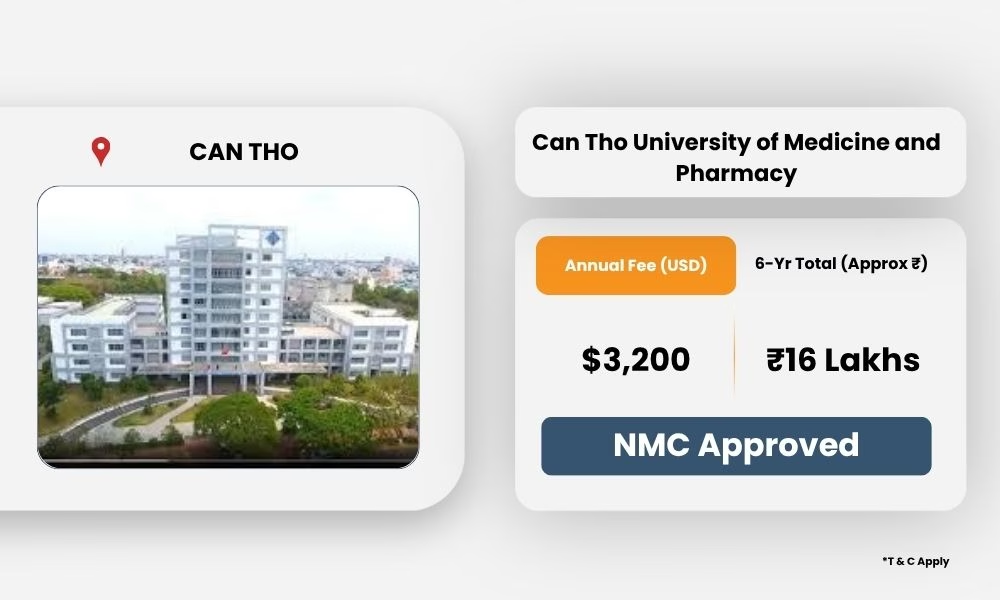
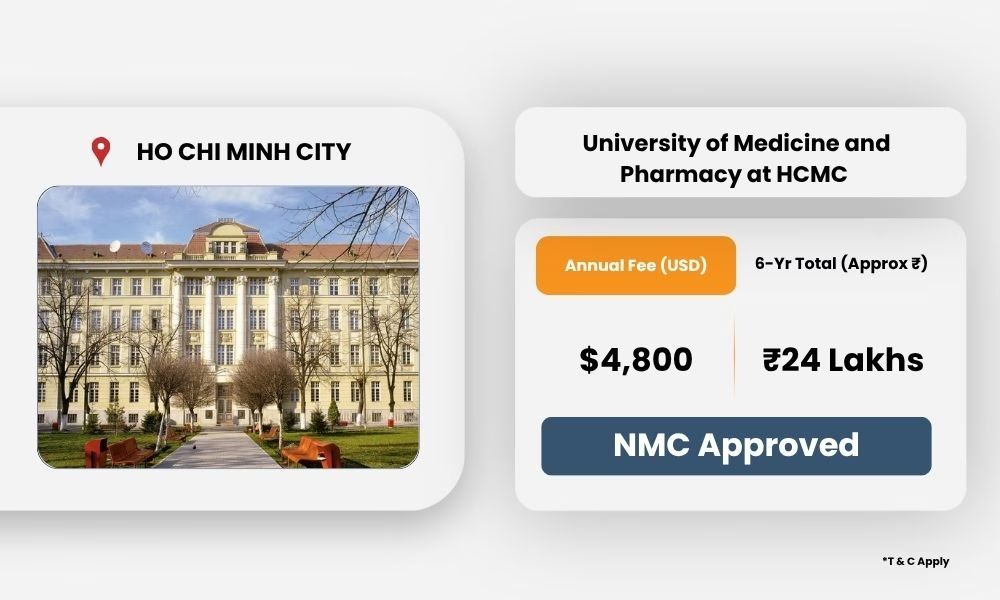
The MBBS fees in Vietnam for Indian students are among the lowest globally. Total cost of MBBS in Vietnam (tuition + hostel + food) ranges from ₹18–32 lakhs for 6 years — up to 5× cheaper than private Indian medical colleges.
MBBS in Vietnam Without Donation
Pay only the officially published university tuition fee. MBBS in Vietnam without donation is guaranteed at all our partner institutions — zero capitation fees, zero management quota, and zero hidden charges. Your financial commitment is transparent and fixed from day one of enrollment.
Direct Admission with Low NEET Score
Vietnam is an excellent option for MBBS in Vietnam with low NEET score. Only a NEET qualifying score is required for admission — no rank cutoff, no additional entrance test, no merit list pressure. Direct admission to MBBS in Vietnam is open for all eligible Indian students right now.
Globally Recognised MD Degree from Vietnam
The MD degree from Vietnam is recognised in India after clearing FMGE/NEXT. It is also widely accepted for USMLE (USA), AMC (Australia), PLAB (UK), and medical licensing in 40+ countries after completing the respective national screening examinations.
English Medium MBBS in Vietnam
All top universities in Vietnam offer MBBS in English with experienced international faculty. Vietnamese is taught as a separate communication subject from Year 2 to support patient interactions during clinical rotations, while all core academics and examinations remain in English.
Best & Top NMC Approved Medical Universities in Vietnam
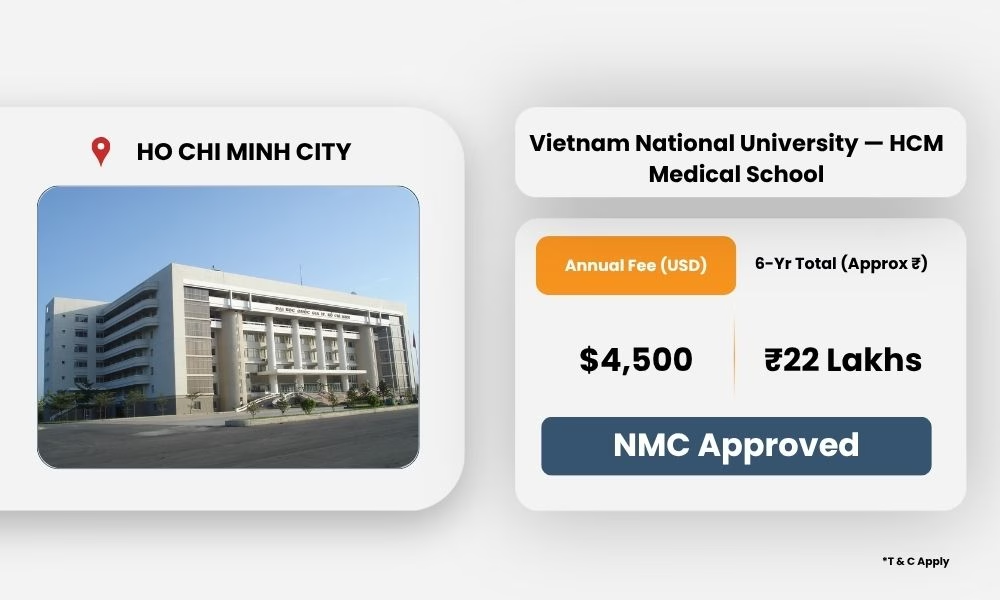
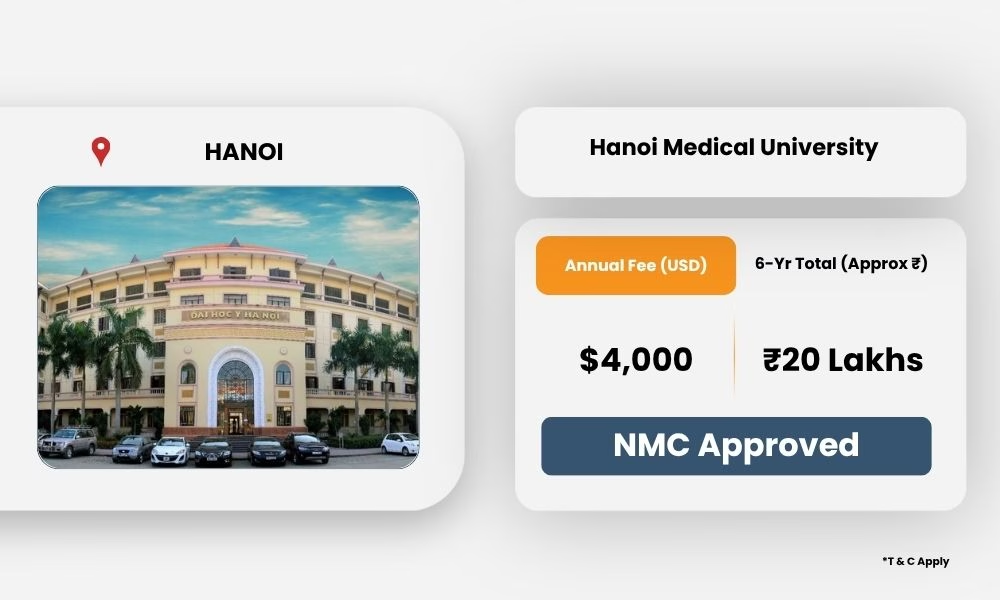
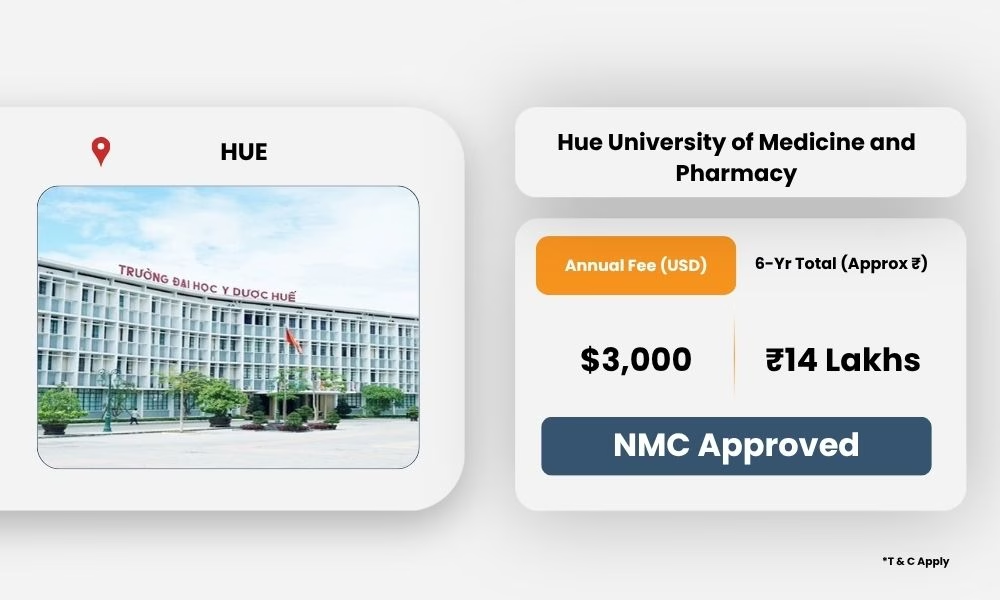
Selecting the right institution is the most critical step when you apply for MBBS in Vietnam. Below is a curated list of the top medical universities in Vietnam for MBBS that are NMC approved, WHO listed, and trusted by Indian students and families for delivering quality medical education.
MBBS in Vietnam Admission Process — Step by Step for Indian Students
The admission process for MBBS in Vietnam is straightforward when guided by experts. Here is how Indian students can apply for MBBS in Vietnam directly without any hassle.
Choose the Right NMC Approved University in Vietnam
Shortlist the best university for MBBS in Vietnam based on your NEET score, budget, city preference, and FMGE pass record. Our free counselling session helps you pick the perfect match.
Submit Application & Documents Online
Fill out the university application form and submit documents including your NEET scorecard, 10+2 marksheets, and passport. Applications for MBBS Vietnam intake are open now.
Receive Official Invitation Letter
After document verification, the university issues a formal invitation letter — the key document required to apply for a Vietnam student visa for MBBS. Processing takes 2–4 weeks.
Apply for Vietnam Student Visa
Submit your student visa application for MBBS in Vietnam at the Russian Embassy/Consulate in India. We provide complete visa assistance for MBBS in Vietnam — documentation, checklist, and appointment support.
Travel toVietnam & University Registration
Fly to Vietnam and complete airport pickup, hostel check-in, and university registration. Our on-ground team in Vietnam assists with initial settlement, SIM card, and bank account setup.
Begin Your 6-Year MBBS / MD Program
Start your 6-year MBBS program in Vietnam with English-medium lectures. Clinical rotations begin from year 3. FMGE/NEXT coaching is integrated from year 1 at select universities.
MBBS in Vietnam Fees for Indian Students
Complete Fee Breakdown — Transparent & Affordable Medical Education
Annual Cost Breakdown (Per Year)
- 💰 Tuition Fee: $3,000 – $4,800/year
- 🏠 Hostel / Accommodation: $500 – $900/year
- 🍽️ Food & Living Expenses: $1,000 – $1,800/year
- ✈️ Travel (India ↔ Vietnam): ₹25,000 – ₹50,000/yearr
- 🛡️ Medical Insurance: ~$120/year
- 📄 One-Time Visa & Processing: ₹15,000 – ₹30,000
Total MBBS Cost in Vietnam (6 Years)
- 🎓 Budget University: ₹14 – ₹18 Lakhs
- 🏫 Mid-Range University: ₹19 – ₹23 Lakhs
- ⭐ Premium University: ₹24 – ₹30 Lakhs
- 🇮🇳 vs India Private College: ₹60 – ₹1.2 Crore
- 🚫 No Donation / No Capitation Fee
- 🏦 Education Loan Available via Indian Banks
MBBS in Vietnam Eligibility
Simple Requirements. Easy Admission Process for Indian Students
🎓 Academic Qualification
10+2 with PCB (Physics, Chemistry & Biology) & minimum 50% (45% for reserved categories). Recognised board required.
📝 NEET Qualification
NEET is mandatory as per NMC. Only qualifying marks required.
🎂 Age Criteria
Minimum 17 years before Dec 31. No upper age limit.
📄 Documents Required
- 10th & 12th Marksheets
- NEET Scorecard
- Passport (3+ Years Valid)
- Passport Size Photos
- Medical Fitness Certificate
- Affidavit of Genuineness
FMGE / NEXT Exam After MBBS in Vietnam — What You Need to Know
After completing your MBBS from Vietnam, Indian students must clear the FMGE (Foreign Medical Graduate Exam) — now being replaced by NEXT (National Exit Test) — to practice medicine in India. Here is what you should know about the FMGE pass rate for Vietnam MBBS graduates:
FMGE / NEXT Key Facts
- Conducted by: National Board of Examinations (NBE)
- Eligibility: Graduate from WHO/NMC approved foreign university
- Subjects: 19 medical subjects, 300 MCQs
- Passing marks: 150/300 (50%)
- Attempts: Unlimited until cleared
- Top Russia FMGE passers: Sechenov, RUDN, Kazan
How to Improve FMGE Pass Rate
- Choose a university with integrated FMGE coaching
- Start FMGE preparation from year 1 of MBBS
- Attend regular mock tests & revision sessions
- Join India-based FMGE crash courses before return
- Prefer universities with higher clinical exposure
- Connect with FMGE-cleared alumni from your university
VIETNAM MEDICAL LICENSING EXAM
Step-by-Step Guide for Indian MBBS Abroad Counselling
Purpose. This guide combines the main steps for a graduate seeking authorisation to practise medicine in Vietnam and the separate pathway for an Indian student who plans to return to India.
Vietnam licensing pathway: key steps
| Step | What the Student Must Do | Purpose / Outcome |
|---|---|---|
| 1. Complete the medical degree | Complete the prescribed medical programme in Vietnam and obtain the final degree and academic records. | The medical qualification is the starting point for the licensing pathway. |
| 2. Build Vietnamese-language proficiency | Develop the language skills needed for patient communication, history-taking, clinical instructions and hospital practice. | The exact language level and examination language for foreign graduates must be confirmed from official rules. |
| 3. Complete post-degree hospital practice | The Indian Embassy advisory identifies 12 months of hospital practice after the undergraduate medical degree for Vietnam's licensing route. Confirm the placement, supervision and applicable rules directly with the competent authority. | Do not assume that clinical rotations completed during the degree automatically count toward this post-degree requirement. |
| 4. Obtain proof of practical training | Secure official documentation from the authorised hospital or competent authority confirming completion of the required practical training. | Proof of training may be needed for examination eligibility and the licence application. |
| 5. Confirm eligibility and register for the assessment | Check the National Medical Council's official notice for eligibility of foreign-trained graduates, application dates, required documents, fees and registration procedure. | The national competency assessment is planned to begin in 2027; verify the current official schedule. |
| 6. Prepare for and take the competency assessment | Follow the official syllabus, language, examination format, venue and candidate instructions when published. | Do not assume the question count, duration, pass mark or retake rules before official publication. |
| 7. Pass the assessment | Meet the published pass criteria and obtain official confirmation of the result. | Passing the assessment is one part of the licensing process; it is not, by itself, the practice licence. |
| 8. Submit the practice-licence application | Submit the prescribed application and required documents, which may include degree and identity documents, proof of practical training, assessment results, health documents and applicable fees. | The final document list and submission authority must be checked against the current Vietnamese rules. |
| 9. Receive the licence and complete practice registration | Wait for approval from the competent licensing authority. Complete any separate registration of the place of practice required by the applicable rules. | Practise only after the required licence or authorisation has been granted and any additional requirements are met. |
If the student plans to return to India
- Check NMC compliance: Verify the university, qualification, course duration, medium of instruction, clinical training and internship against the NMC rules applicable to the student’s admission batch.
- Meet Indian licensing requirements: Follow the applicable screening/licensing examination route (FMGE or any successor framework in force), plus internship requirements where applicable.
- Apply for registration: Apply to the relevant State Medical Council and meet the registration requirements before practising in India.
- Embassy of India, Hanoi — advisory for Indian students pursuing medical education in Vietnam (5 June 2026)
QUESTIONS / ANSWERS
Frequently asked questions
Vietnam is becoming a popular MBBS-abroad destination because several universities offer English-medium medical programmes, modern campuses, hostel facilities, and comparatively affordable tuition. Students should select only universities with strong academic standards, clinical exposure, and a course structure that meets NMC requirements.
The Indian Embassy in Hanoi states that the undergraduate medical programme in Vietnam is six years. Students should confirm the exact curriculum and clinical-training schedule with their chosen university.
Yes. Most medical universities in Vietnam provide secure university-affiliated accommodation equipped with Wi-Fi, heating/cooling, and security. Indian messes or self-cooking kitchens are widely available on or near campus to cater to South Asian diets.
- Tuition Fees: Ranges between $3,000 to $6,000 USD per year (approx. ₹2.5 Lakh to ₹5 Lakh per year) depending on the university.
- Total 6-Year Expenses: The total budget—including tuition, hostel accommodation, food, and living expenses for 6 years—ranges between ₹25 Lakh to ₹35 Lakh INR.
Living costs depend on the city and lifestyle. Students may spend approximately ₹10,000–₹30,000 per month on accommodation, food, transport, and personal expenses. Hanoi and Ho Chi Minh City are usually more expensive than smaller cities.
Typical process includes:
- Counselling and university selection
- Submission of academic documents, passport copy, and NEET scorecard
- Receipt of the admission letter
- Payment of initial fees
- Visa invitation and student visa processing
- Travel to Vietnam and university registration
Students do not usually need full Vietnamese proficiency for an English-medium programme, but basic Vietnamese is helpful and often necessary for patient interaction during hospital rotations and daily life.
English-language test requirements differ between universities. Some institutions may accept previous English-medium education or other proof of proficiency, while others may require a recognised test score. Confirm the current requirement directly with the university.
The Indian Embassy's advisory dated 5 June 2026 states that Vietnam is to introduce a centralised government licensing examination from 2027. The advisory says the examination will likely be conducted in Vietnamese. Students should verify the final implementation date, eligibility, format and language with the Vietnamese authorities, as details may be updated.
Students should verify the university's legal status and authority to award the medical degree; the exact degree title; medium of instruction; complete curriculum; clinical training locations and duration; internship arrangements; Vietnamese-language requirements; local licensing pathway; and compliance with the latest NMC regulations. Request supporting documents directly from the university.