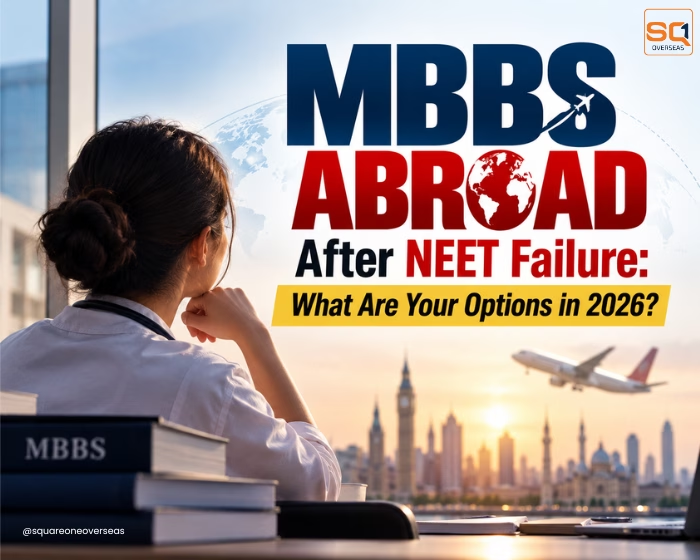
NEET qualification is an important eligibility requirement for Indian students planning to pursue an undergraduate medical degree abroad. After receiving your NEET result, the next steps are to assess eligibility, set a realistic budget, shortlist countries and universities, verify the programme against applicable NMC requirements, prepare documents, submit the university application, complete admission formalities, apply for a student visa and prepare for departure. Qualifying NEET does not by itself guarantee admission, Indian medical registration or a particular university seat.

What Happens After Qualifying NEET for MBBS Abroad?
Qualifying NEET is the beginning of your overseas MBBS planning process, not the final admission step.
For Indian students considering foreign medical education, the roadmap generally looks like this:
NEET Result → Eligibility Check → Budget Planning → Country Shortlisting → University Verification → Application → Admission/Offer Letter → Visa → Pre-Departure → University Joining
The most important principle is to evaluate the university and medical programme, rather than choosing a country based only on low fees or easy admission.
The Ministry of External Affairs also advises Indian students travelling abroad for education to check that their foreign university or college is accredited and recognised and to obtain the appropriate study visa.
Step-by-Step Roadmap for MBBS Abroad After NEET 2026
Step 1: Check Your NEET Qualification and Academic Eligibility
Before contacting a university, confirm that you meet the applicable eligibility requirements.
For MBBS admission, NMC information specifies NEET qualification and academic requirements. Current NMC guidance states:
| Category | Qualifying percentile |
|---|---|
| General / UR / EWS | 50th percentile |
| OBC / SC / ST | 40th percentile |
| General / UR / EWS-PwBD | 45th percentile |
| OBC / SC / ST-PwBD | 40th percentile |
The exact marks corresponding to a percentile can change each year, so students should use their official NEET result/scorecard rather than relying on an old marks cutoff.
Important distinction
NEET qualification ≠ guaranteed MBBS admission.
Your overseas options can depend on:
- NEET qualification
- Class 12/10+2 subjects and marks
- Age eligibility
- University-specific requirements
- Available seats
- Country regulations
- Total budget
- Course structure
- Applicable NMC requirements
Step 2: Understand What Your NEET Score Means
A common mistake is to ask:
“I qualified NEET. Which country should I choose?”
A better question is:
“Which medical universities fit my NEET result, academic profile, budget and long-term career plans?”
A higher NEET score does not automatically make a particular foreign university suitable, while a qualifying score does not automatically make every foreign university suitable.
Therefore, use your NEET result as one part of your eligibility assessment.
Step 3: Set Your MBBS Abroad Budget
Before selecting a university, calculate the total cost, not just tuition fees.
Your budget should include:
| Expense | What to consider |
|---|---|
| Tuition fee | Annual and complete programme fee |
| Hostel | University accommodation or private housing |
| Food | Monthly food expenses |
| Travel | Flights to and from India |
| Visa | Application and related charges |
| Insurance | Health/travel insurance where applicable |
| Documentation | Translation, authentication, apostille/attestation |
| Local transport | Daily travel |
| Books & equipment | Academic expenses |
| Emergency fund | Unexpected expenses |
Ask the university or authorised representative for a written fee structure, including payment schedule, refund policy and additional charges.
Avoid selecting a university only because its advertised tuition fee is low.
Step 4: Which Countries Can NEET Qualified Students Consider for MBBS Abroad?
Indian students commonly research destinations such as:
- Russia
- Kazakhstan
- Kyrgyzstan
- Uzbekistan
- Vietnam
- Georgia and other destinations offering medical programmes
However, there is no universal country ranking that determines which destination is suitable for every student.
Instead, compare individual universities using factors such as:
| Factor | What to verify |
|---|---|
| Recognition | Is the university legally recognised in its country? |
| Programme | Does the specific medical programme satisfy applicable requirements? |
| Duration | Does the programme meet applicable NMC requirements? |
| Medium | What is the actual teaching language? |
| Clinical training | Where and how is clinical training conducted? |
| Internship | Where is the internship completed? |
| Licensing | What registration/licensing does the degree provide in that country? |
| Fees | What is the complete cost? |
| Accommodation | What facilities are provided? |
| Hospital exposure | Which teaching hospitals are involved? |
| Student support | What assistance is available? |
The NMC itself advises students to conduct due diligence rather than treating an advertised university list as an endorsement.
Step 5: Verify the University Against Current NMC Requirements
This is one of the most important stages of MBBS abroad admission.
The NMC’s Foreign Medical Graduate Licentiate Regulations, 2021 establish requirements relevant to foreign medical graduates seeking registration to practise medicine in India. The NMC’s published FMGL FAQs include requirements concerning the duration of medical education, internship, curriculum, clinical training and registration in the country where the qualification is awarded.
Key areas to verify
1. Course duration
The applicable regulations specify a minimum duration of medical education, including the required internship structure.
2. Internship
The FMGL FAQ specifies a minimum 12-month internship in the same foreign medical institution for the applicable pathway.
3. Clinical training
Check where clinical training occurs, which hospitals are involved and how much hands-on exposure students receive.
4. Curriculum
Review the subjects and curriculum instead of relying only on the university’s promotional material.
5. Medium of instruction
Verify the actual teaching arrangement and whether it satisfies the applicable regulatory requirements.
6. Registration in the country of study
The NMC’s FMGL FAQ states that foreign medical graduates need registration with the relevant professional regulatory body in the country awarding the medical degree, under the applicable conditions.
7. Licensing pathway in India
Students should understand the examination and registration requirements applicable when they return to India. NMC regulations and subsequent official notifications should be checked for the latest pathway.
Important
Don’t accept statements such as:
“This university is guaranteed NMC approved.”
Instead, ask for documentary evidence and verify the current regulations yourself.
Step 6: Prepare Documents for MBBS Abroad Admission
Common documents may include:
- NEET scorecard
- Class 10 certificate
- Class 12 certificate/marksheet
- Passport
- Passport-size photographs
- Birth certificate, where required
- Medical fitness certificate
- Academic transcripts
- Application forms
- University-specific declarations
- Financial documents where required
- Other country-specific documents
The exact list varies by university and country.
Do documents need Apostille or Attestation?
This depends on the destination country and the document.
The Ministry of External Affairs explains that apostille is used for countries covered by the Hague Apostille Convention, while normal attestation applies where apostille is not accepted. MEA also provides procedures for authentication and submission of documents.
Step 7: Apply to the University
Once your university shortlist is finalised:
- Complete the application.
- Upload or submit academic documents.
- Submit your NEET details.
- Pay the applicable application fee, if any.
- Wait for document verification.
- Receive the admission decision/offer.
- Review the fee structure and admission conditions.
- Pay the required amount only after verifying the university and terms.
Keep copies of every application, payment receipt and official communication.
Step 8: Receive Your Admission and Invitation Documents
Depending on the country and university, you may receive documents such as:
- Admission/offer letter
- Confirmation of enrolment
- Invitation letter
- Fee receipt
- Accommodation confirmation
- Other documents required for the visa process
Do not book expensive non-refundable travel arrangements before the required admission and visa documentation is confirmed.
Step 9: Apply for Your Student Visa
Visa requirements differ by destination.
Common requirements may include:
- Passport
- Admission letter
- Invitation letter
- Financial proof
- Medical documents
- Photographs
- Visa application form
- Academic certificates
- Insurance, where applicable
- Other country-specific documents
The Ministry of External Affairs advises Indian students to obtain the appropriate study visa from the relevant foreign embassy or consulate.
Always use the official embassy/consulate or designated visa-service information for the latest requirements.
Step 10: Prepare for Departure
After receiving your visa, create a pre-departure checklist.
Before leaving India
- Confirm flight booking
- Arrange accommodation
- Carry original documents
- Keep digital backups
- Carry university contact details
- Arrange sufficient initial funds
- Purchase required insurance
- Understand airport arrival procedures
- Save emergency contact numbers
- Understand local laws and regulations
MEA also recommends that Indian students abroad familiarise themselves with local rules, laws, living conditions and relevant information about the destination.
How Long Does MBBS Abroad Admission Take?
There is no single fixed timeline because it varies by country, university, application season, documentation and visa processing.
A typical planning sequence can look like this:
| Stage | Typical planning period |
|---|---|
| NEET result & eligibility assessment | Immediately after result |
| University shortlisting | 1–2 weeks |
| Document preparation | 1–3 weeks |
| University application | Depends on university |
| Admission processing | University-dependent |
| Visa documentation | After admission documents |
| Visa processing | Country-dependent |
| Travel & joining | After visa approval |
Students should start the process early rather than waiting until seats or visa timelines become restrictive.
What Documents Are Required for MBBS Abroad After NEET?
The exact requirement varies, but students should keep these ready:
Academic Documents
- Class 10 certificate
- Class 12 certificate
- Class 12 marksheet
- NEET scorecard
- Transfer/school leaving certificate, where applicable
Identity Documents
- Passport
- Birth certificate
- Passport photographs
Admission & Visa Documents
- University application
- Admission/offer letter
- Invitation letter, if required
- Financial documents
- Medical certificate
- Insurance documents, where applicable
Additional Documentation
Depending on the country, you may need:
- Attested documents
- Apostilled documents
- Translated documents
- Notarised copies
- Country-specific forms
Always obtain the final checklist from the university and relevant visa authority.
What Should You Check Before Paying for MBBS Abroad?
Use this checklist before making a payment:
University Verification Checklist
☐ University is legally recognised in the destination country
☐ Medical programme is properly recognised
☐ Current NMC requirements have been checked
☐ Course duration has been verified
☐ Internship structure has been verified
☐ Clinical training details are documented
☐ Medium of instruction has been confirmed
☐ Registration/licensing pathway is understood
☐ Complete tuition fee is known
☐ Hostel and living expenses are calculated
☐ Refund policy has been reviewed
☐ Visa requirements have been checked
☐ All claims made by the counsellor are supported by documentation
This approach is more reliable than selecting a university based on advertisements such as “lowest fees,” “100% guaranteed admission” or “guaranteed NMC approval.”
What Are the Common Mistakes Students Make?
1. Choosing Only Based on Fees
The cheapest university is not automatically the most suitable.
Consider the complete cost and academic structure.
2. Believing “NMC Approved” Without Verification
Students should distinguish between NMC regulatory requirements and marketing claims made by universities or agencies.
3. Ignoring Clinical Training
Medical education is not just classroom learning. Ask where clinical training takes place and how students receive practical exposure.
4. Waiting Too Long to Apply
Delaying the process can create pressure around admissions, documentation and visas.
5. Not Checking Internship Details
The internship structure can be critical for future registration eligibility.
6. Paying Before Reading the Refund Policy
Always understand cancellation, withdrawal and refund terms before paying substantial fees.
7. Comparing Countries Instead of Universities
Two universities in the same country can have very different fee structures, facilities, teaching arrangements and clinical exposure.
Expert Tips for NEET Qualified Students Planning MBBS Abroad
Tip 1: Start with compliance, not marketing
First verify whether the programme satisfies applicable regulatory requirements. Then compare fees, accommodation and other preferences.
Tip 2: Ask for written information
If a counsellor tells you something important, ask for supporting documentation.
Tip 3: Compare the total cost
Calculate tuition + hostel + food + travel + visa + insurance + other expenses.
Tip 4: Investigate the clinical component
Ask:
- Which hospitals are used?
- Where are clinical rotations conducted?
- How much hands-on training is provided?
- Is the internship structure documented?
Tip 5: Keep regulatory information current
NMC regulations and notices can change. Don’t make a six-year medical education decision based on an old social media post.
MBBS Abroad After NEET: Simple 10-Step Roadmap
1. Receive NEET result
↓
2. Confirm qualification and academic eligibility
↓
3. Define your total budget
↓
4. Shortlist countries
↓
5. Shortlist universities
↓
6. Verify NMC and university requirements
↓
7. Prepare documents
↓
8. Apply and receive admission documents
↓
9. Complete student visa process
↓
10. Travel and join the university
This roadmap helps students move from NEET qualification to overseas medical admission in a structured way.
Is MBBS Abroad the Right Option After NEET?
That depends on the student’s individual circumstances.
Before deciding, compare:
- Your NEET result
- Indian MBBS options
- Overseas university options
- Total cost
- Family budget
- Academic environment
- Clinical exposure
- Country and university recognition
- Long-term licensing pathway
- Personal readiness to study abroad
The objective should not simply be to secure an admission letter. The objective should be to select a medical education pathway that you understand fully before committing your time and money.
Why Choose Professional Guidance for MBBS Abroad?
MBBS abroad involves significantly more than submitting an application.
Students and parents may need support with:
- NEET eligibility assessment
- University shortlisting
- Country comparison
- NMC/FMGL compliance checks
- Document verification
- Application submission
- Admission processing
- Visa documentation
- Pre-departure guidance
A professional overseas education consultancy can help organise these stages, but students and parents should still independently verify important university and regulatory information before making a final decision.
Plan Your MBBS Abroad Journey With SquareOne Overseas
If you have qualified NEET 2026 and are exploring MBBS abroad, SquareOne Overseas can help you understand your available options based on your NEET result, academic profile, budget and preferred destination.
From university shortlisting and application support to documentation, admission and visa guidance, our team can help you navigate the process step by step.
Ready to explore MBBS abroad after NEET? Speak with SquareOne Overseas for personalised MBBS abroad counselling and understand your 2026 options.