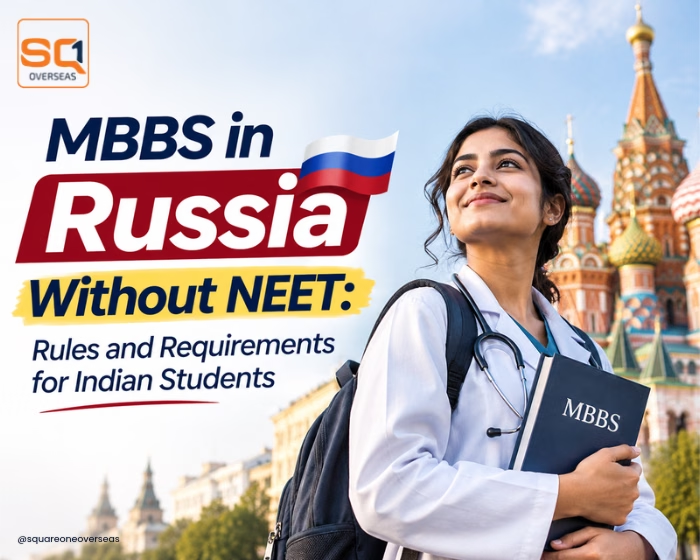

Can You Study MBBS in Russia Without NEET?
Indian students who wish to pursue MBBS in Russia must qualify for NEET-UG if they intend to obtain medical registration in India after graduation. According to the NTA NEET-UG 2026 Information Bulletin, Indian citizens and OCI candidates planning to study undergraduate medicine abroad must qualify for NEET. Although individual Russian universities may have their own admission procedures, admission without NEET does not remove India’s medical licensing requirements. Students should verify both university admission criteria and NMC regulations before applying.
Studying MBBS in Russia has become an option for many Indian students who want to pursue medical education abroad. Russian medical universities attract international students through English-medium programmes, established medical institutions and different tuition fee options.
However, one question frequently asked by students and parents is: Can I study MBBS in Russia without NEET?
Some students believe that studying medicine outside India means they do not need to qualify for NEET. Others assume that securing admission to a Russian medical university automatically makes them eligible to practise in India.
Both assumptions can create serious problems.
The National Medical Commission (NMC) regulates the eligibility of Indian students who complete their medical education abroad and wish to practise in India. Therefore, understanding the NEET requirement, Foreign Medical Graduate Licentiate (FMGL) Regulations, 2021, and admission requirements is essential before choosing a university.
This guide explains the latest rules, eligibility requirements, admission process and important considerations for Indian students planning to study MBBS in Russia in 2026.
1. Is NEET Compulsory for MBBS in Russia for Indian Students?
Yes. NEET qualification is required for Indian citizens and OCI candidates who intend to pursue undergraduate medical education in a foreign country, including Russia.
The National Testing Agency (NTA), in its NEET-UG 2026 Information Bulletin, specifically states that Indian citizens and Overseas Citizens of India (OCI) intending to pursue undergraduate medical courses in foreign medical institutions must qualify for NEET.
This requirement is important for students planning to return to India and obtain medical registration after completing their degree.
The NEET requirement is not limited to admission into Indian medical colleges. It also applies to Indian students planning to obtain their primary medical qualification from foreign universities.
Why is NEET qualification important?
NEET qualification establishes the required eligibility for Indian students pursuing medical education abroad. It is also an important requirement under the regulatory framework governing foreign medical graduates.
Consider these points:
- NEET qualification is required for Indian citizens and OCI candidates pursuing undergraduate medical education abroad.
- A Russian university’s admission offer does not replace NEET qualification.
- Students must satisfy the applicable NMC regulations to become eligible for medical registration in India.
- Students should not rely on claims that NEET is unnecessary simply because a foreign university offers direct admission.
Therefore, qualifying for NEET should be treated as an essential step before proceeding with MBBS abroad.
2. Can I Get Admission to MBBS in Russia Without NEET?
The answer depends on the university’s admission policy and the student’s nationality. Some Russian universities may conduct their own entrance examinations or assess international applicants using their Class 12 academic records.
However, university admission and eligibility to practise medicine in India are two separate matters.
A university may assess an international student’s academic qualifications according to its admission rules. That does not mean an Indian student who has not qualified for NEET automatically becomes eligible for Indian medical registration.
For example, a student might receive an admission offer based on Class 12 marks or an internal entrance examination. However, if the student has not met the applicable NEET requirement, the admission offer itself does not establish eligibility to return to India and practise medicine.
Important distinction
| Admission or eligibility factor | What it means |
|---|---|
| Russian university admission | Depends on the university’s admission policy |
| NEET qualification | Required for Indian citizens and OCI candidates pursuing medicine abroad |
| NMC regulations | Determine eligibility for medical registration in India |
| Medical licensing examination | Must be cleared as applicable under the prevailing Indian regulations |
| Indian registration | Required before independently practising medicine in India |
Expert advice: Never choose a university based only on its promise of direct admission without NEET. First, understand the regulatory consequences and confirm your eligibility for the country where you intend to practise.
3. What Are the Eligibility Requirements for MBBS in Russia?
Indian students planning to pursue MBBS in Russia must satisfy the applicable Indian eligibility requirements as well as the admission conditions of their chosen Russian university.
The following are the major factors to consider.
1. Educational Qualification
Students should have completed Class 12 or an equivalent qualification with:
- Physics
- Chemistry
- Biology or Biotechnology
- English
The qualifying examination must meet the applicable NTA and NMC requirements.
2. NEET Qualification
Indian citizens and OCI candidates must qualify for NEET-UG before pursuing undergraduate medical education abroad.
For NEET-UG 2026, the qualifying percentile for the general and General-EWS categories is 50th percentile. For SC, ST and OBC candidates, it is 40th percentile, subject to applicable provisions and any officially notified changes.
Students should check the qualifying criteria for the specific examination year.
3. Minimum Age
Candidates must have completed 17 years of age on or before 31 December of the relevant year, as prescribed under the applicable NEET eligibility rules.
4. University-Specific Requirements
Russian universities may have additional requirements, such as:
- Class 12 mark sheets
- Passport
- Medical fitness certificate
- Birth certificate
- Passport-size photographs
- University application form
- Entrance examination or interview, where applicable
These requirements can differ between universities and admission cycles.
MBBS in Russia Eligibility: Quick Overview
| Requirement | Details |
|---|---|
| Academic qualification | Class 12 or equivalent |
| Core subjects | Physics, Chemistry and Biology/Biotechnology |
| English | Required as part of the qualifying academic subjects |
| NEET | Must be qualified by Indian citizens and OCI candidates |
| Minimum age | 17 years by 31 December of the relevant year |
| Passport | Valid passport required for international admission and travel |
| Medical fitness | As required by the university |
| Entrance examination | Depends on the university |
Meeting the basic eligibility conditions does not guarantee admission. Each university may have its own selection process, academic requirements and available seats.
4. What Are the NMC Rules for Studying MBBS Abroad?
The National Medical Commission regulates foreign medical graduates who wish to obtain medical registration in India.
The Foreign Medical Graduate Licentiate (FMGL) Regulations, 2021, specify the conditions that foreign medical graduates must satisfy to become eligible for permanent registration in India.
These rules are particularly important for Indian students choosing Russian medical universities.
Key NMC Requirements for MBBS Abroad
1. Minimum Course Duration of 54 Months
The medical degree programme must have a minimum duration of 54 months in the same foreign medical institution.
2. Twelve-Month Internship in the Same University
Students must complete an internship of at least 12 months at the same foreign medical institution.
This internship is separate from the clinical training and postings included in the academic programme.
3. English as the Medium of Instruction
The foreign medical degree must be taught in English.
Students should verify that the complete programme satisfies this requirement rather than relying only on a university’s claim that it offers an English-medium course.
4. Mandatory Medical Subjects
The curriculum must cover the mandatory subjects specified in Schedule I of the FMGL Regulations, 2021, and must provide education and clinical training equivalent to the prescribed Indian medical curriculum.
5. Registration in the Country of Study
Graduates must be registered with the relevant professional regulatory authority or otherwise hold the required licence to practise medicine in the country where the degree was awarded. This must be equivalent to the licence available to citizens of that country.
6. Twelve-Month Internship in India
After fulfilling the applicable requirements, foreign medical graduates must undergo a supervised internship in India for a minimum of 12 months, following the prescribed process.
7. Licensing Examination
Students must clear the National Exit Test (NExT) or such other examination as may be mandated by the NMC.
The applicable examination and registration requirements must be checked at the time of graduation.
Why Should Students Follow NMC Regulations?
A medical degree from a foreign university does not automatically provide the right to practise in India.
If the programme does not satisfy the prescribed requirements, the graduate may face difficulties obtaining eligibility for licensing examinations and medical registration.
Therefore, students should evaluate the university’s curriculum, duration, internship structure, language of instruction and licensing arrangements before paying admission fees.
5. Is MBBS in Russia Valid in India Without NEET?
No. An Indian student who has not qualified for NEET cannot assume that an MBBS degree obtained in Russia will make them eligible for medical registration in India.
NEET qualification is a separate eligibility requirement for Indian citizens and OCI candidates pursuing medical education abroad.
Even if a student completes the medical programme successfully, they must satisfy the applicable NMC requirements before obtaining registration in India.
For students planning to return to India, the following conditions are particularly important:
- NEET qualification before pursuing medical education abroad.
- Compliance with the FMGL Regulations, 2021.
- Completion of the prescribed medical course and internship.
- Eligibility for the applicable licensing examination.
- Completion of the required supervised internship in India.
- Obtaining the relevant medical registration.
Can You Practise in Russia After Completing MBBS?
This is another important consideration.
Students must understand the licensing requirements applicable to foreign medical graduates in Russia. Completing a degree alone should not be assumed to provide an unrestricted right to practise.
The Russian regulatory authority’s requirements, including any necessary accreditation or licensing examinations, should be confirmed directly with the university and competent authorities.
This is especially important for students who want to pursue medical careers outside India.
6. What Is the MBBS Admission Process in Russia for Indian Students?
The admission process generally involves academic assessment, university selection, document submission and student visa processing.
Here is a step-by-step overview.
Step 1: Check Your Eligibility
Review your Class 12 academic qualifications, NEET qualification status and age eligibility.
Step 2: Shortlist Russian Medical Universities
Compare universities based on:
- Course duration
- Medium of instruction
- Curriculum
- Clinical training facilities
- Internship arrangements
- University admission requirements
- Licensing eligibility
- Tuition fees and hostel facilities
Step 3: Verify NMC Compliance
Check whether the proposed programme satisfies the applicable FMGL requirements.
Do not rely only on university brochures or consultancy advertisements. Request official documents and verify programme details directly with the university.
Step 4: Submit Your Application
Prepare and submit the documents requested by the university. These may include academic certificates, passport copies, photographs and medical documents.
Step 5: Receive the Admission Offer
After the application is reviewed and the selection process is completed, the university may issue an admission or invitation document.
Step 6: Complete Fee and Visa Formalities
Follow the university’s official payment procedure. After receiving the required invitation documents, apply for the appropriate Russian student visa.
Step 7: Travel and Complete University Registration
Once the visa is approved, students can make travel arrangements and complete the university’s enrolment formalities.
Important: The admission process, examination requirements, deadlines and documentation may vary between universities and academic years.
7. What Documents Are Required for MBBS Admission in Russia?
Students should prepare their academic and personal documents in advance to avoid delays during the admission process.
Commonly requested documents include:
| Document | Purpose |
|---|---|
| Class 10 certificate | Age and academic verification |
| Class 12 mark sheet | Educational qualification |
| NEET scorecard | Evidence of NEET qualification |
| Valid passport | International identification |
| Passport-size photographs | University application |
| Birth certificate | Personal information verification |
| Medical fitness certificate | Health documentation |
| Admission application | University enrolment |
| Other university-specific documents | Additional verification |
Some documents may require translation, notarisation or legalisation, depending on the university and applicable procedures.
Students should confirm the exact document checklist before submission.
8. Common Mistakes to Avoid When Choosing MBBS in Russia
Choosing a medical university is a major academic and financial decision. Students and parents should avoid making decisions based only on low tuition fees or attractive admission offers.
Here are some common mistakes.
Mistake 1: Believing That NEET Is Not Required Abroad
Some students assume that NEET applies only to Indian medical colleges.
However, Indian citizens and OCI candidates must qualify for NEET when pursuing undergraduate medical education abroad.
Mistake 2: Selecting a University Based on Low Fees
A lower tuition fee does not automatically mean better value.
Students should evaluate the complete course structure, clinical facilities, internship arrangements and compliance with Indian regulations.
Mistake 3: Ignoring the Medium of Instruction
A programme advertised as English-medium should be checked carefully.
Students must ensure that the degree satisfies the English-medium requirement under the FMGL Regulations.
Mistake 4: Overlooking Internship Requirements
Clinical postings during the course and the compulsory internship are not interchangeable.
The required internship must be completed at the same foreign medical institution under the applicable regulations.
Mistake 5: Trusting Guaranteed Admission or Registration Claims
No consultancy or university should be trusted solely because it promises guaranteed Indian medical registration.
Students should independently verify official requirements and obtain written clarification wherever necessary.
9. Expert Tips Before Applying for MBBS in Russia
Before making a final decision, Indian students should follow these practical recommendations:
- Qualify for NEET: Complete the NEET requirement before proceeding with foreign medical education.
- Verify the university: Review the university’s official website, programme structure and relevant approvals.
- Check the course duration: Ensure that the programme meets the minimum 54-month requirement.
- Confirm internship arrangements: Verify the 12-month internship at the same foreign institution.
- Review the curriculum: Check the subjects and clinical training against Schedule I of the FMGL Regulations.
- Confirm English-medium teaching: Obtain clear documentation about the language of instruction.
- Understand local licensing: Find out how graduates obtain the right to practise in Russia.
- Calculate the total cost: Include tuition, hostel, food, travel, insurance and other expenses.
- Get everything in writing: Keep official admission documents, fee receipts and university communications.
These steps can help students make informed decisions and reduce the risk of regulatory or academic complications later.
10. Is MBBS in Russia a Good Option for Indian Students?
Russia can be considered by Indian students looking for international medical education. However, the suitability of a particular university depends on the student’s academic profile, financial capacity, career goals and willingness to adapt to a different educational and cultural environment.
Before selecting Russia, consider the following factors:
| Factor | What Students Should Evaluate |
|---|---|
| Academic quality | Curriculum, faculty and teaching standards |
| Clinical exposure | Hospital facilities and patient interaction |
| Language | English-medium education and Russian language learning |
| Course duration | Compliance with NMC requirements |
| Internship | Duration and location of internship |
| Financial planning | Tuition, accommodation and living expenses |
| Licensing | Eligibility for medical practice in the intended country |
Russian language skills can also be important during clinical interactions with local patients, even when the academic programme is advertised as English-medium.
Therefore, students should consider both academic requirements and practical training conditions before accepting an offer.
Conclusion: Understand NEET Rules Before Choosing MBBS in Russia
MBBS in Russia can be an option for Indian students interested in pursuing medical education abroad. However, NEET qualification remains an essential requirement for Indian citizens and OCI candidates planning to study medicine in foreign universities.
More importantly, students must understand that obtaining admission to a Russian medical university and becoming eligible to practise in India are two different processes.
The NMC’s Foreign Medical Graduate Licentiate Regulations, 2021, prescribe specific requirements relating to course duration, English-medium education, clinical training, internship and licensing.
Therefore, students should not make admission decisions based only on promises of direct admission without NEET or low tuition fees. Proper university verification and regulatory guidance can help protect their academic investment and future medical career.
Planning to Study MBBS in Russia?
Choosing the right medical university requires more than comparing admission offers. You need to understand eligibility, NEET requirements, university selection, documentation and NMC regulations.
At SquareOne Overseas, we help aspiring medical students explore MBBS Abroad opportunities with profile assessment and admission guidance.
Our team can assist with:
- MBBS eligibility assessment
- University shortlisting
- Admission application guidance
- Documentation support
- Student visa assistance
- Pre-departure guidance
Start your MBBS Abroad journey with the right information.
Visit SquareOne Overseas or contact our team to discuss your MBBS in Russia options.