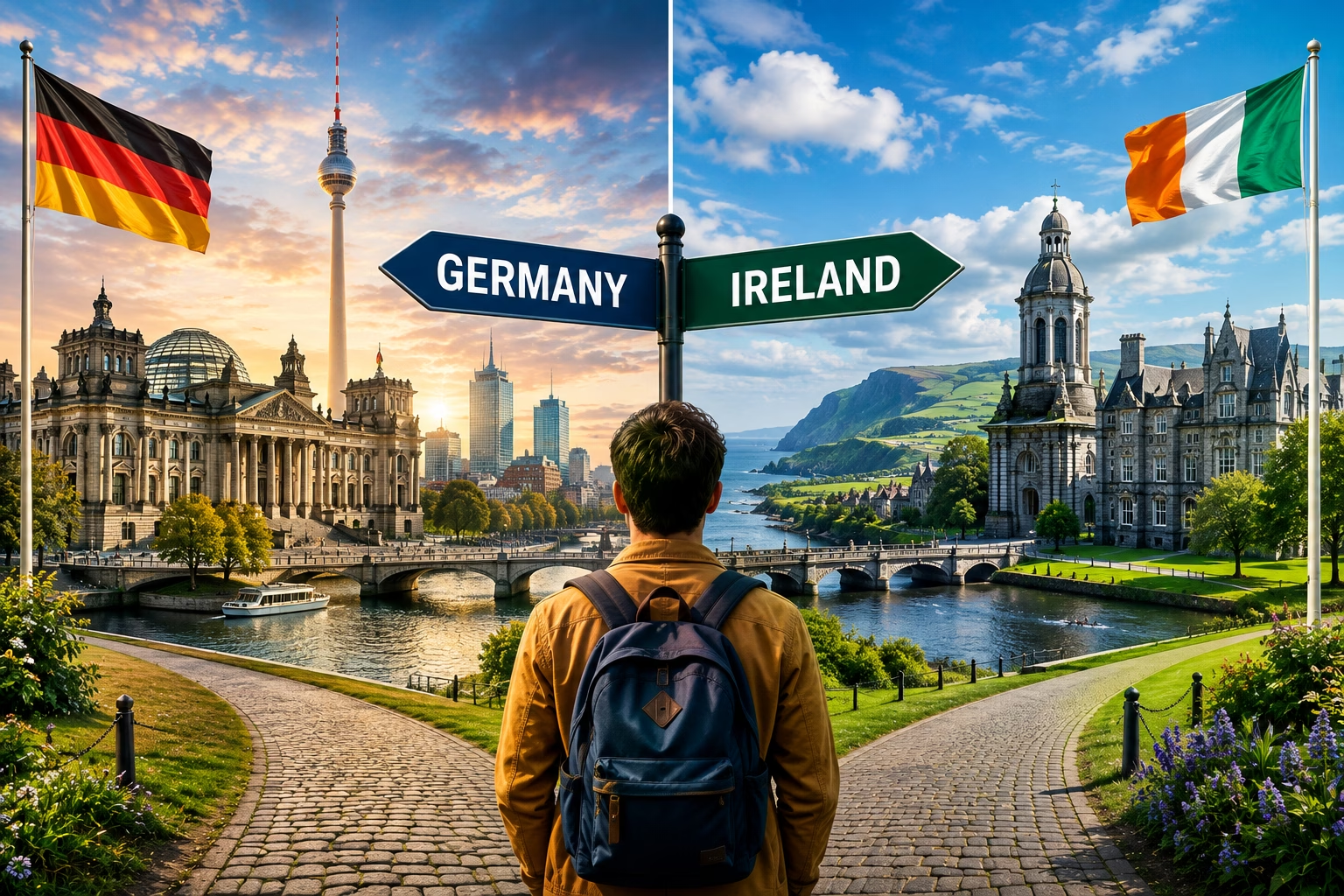
Choosing between Germany and Ireland for a Master’s degree in 2026 depends on more than university rankings. Indian students should compare
tuition fees, living costs, course duration, English-taught programs, part-time work options, post-study work opportunities, employment prospects, immigration pathways, and long-term ROI.
Germany is generally stronger for students prioritising
affordability, engineering, technology, research, and long-term career opportunities in Europe. Ireland can be more attractive for students who prioritise
English-speaking education, technology and business careers, shorter postgraduate programs, and access to multinational companies.
The right choice ultimately depends on your academic profile, budget, chosen course, career target, and willingness to learn the local language.
Germany or Ireland for Masters in 2026?
Germany is usually the better option for students seeking lower tuition costs and strong long-term value, especially in engineering, technology, data science, automotive, and research. Most public German universities charge no or low tuition for many Master’s programs, although exceptions exist. Ireland is often better for students who want an English-speaking environment, a strong multinational technology and pharmaceutical ecosystem, and a straightforward graduate pathway. Ireland can also have higher tuition and accommodation costs. For ROI, Germany generally has the cost advantage, while Ireland can offer strong career opportunities in selected sectors.
Germany vs Ireland for Masters: At a Glance
| Factor |
Germany |
Ireland |
| Tuition fees |
Low at many public universities; exceptions apply |
Generally higher for international students |
| Typical Master’s duration |
Often 1.5–2 years |
Many Master’s programs are 1 year |
| Language |
Many English-taught Master’s; German helps for employment |
English-speaking |
| Cost advantage |
Strong |
Moderate |
| Popular fields |
Engineering, CS, AI, Automotive, Data Science, Research |
IT, Data Science, Business, Finance, Pharma, Engineering |
| Student work |
Up to 140 full days or 280 half days annually under current rules |
Part-time work subject to student immigration conditions |
| Post-study pathway |
Up to 18 months to seek skilled employment after graduation |
Stamp 1G can provide up to 24 months for eligible Master’s graduates |
| Long-term residence |
Possible through skilled employment and qualifying residence |
Possible through qualifying employment-based residence |
| PR/citizenship |
Depends on residence status and eligibility |
Depends on reckonable residence and immigration status |
| Best for budget-conscious students |
Germany |
Ireland |
| Best for English-only environment |
Moderate |
Ireland |
| Best for engineering/automotive |
Germany |
Good |
| Best for tech/pharma ecosystem |
Strong |
Strong |
| Overall ROI |
Germany for cost-conscious students |
Strong for high-demand careers |
Important: Immigration rules, tuition fees and university requirements can change. Students should verify the latest requirements with the relevant government authority and university before making a final decision.
Why Should You Consider Germany for a Master’s in 2026?
Germany has become one of Europe’s most attractive destinations for international Master’s students because of its combination of
high-quality higher education, relatively low tuition costs, research strength and industrial employment opportunities.
According to the official German government portal, Germany has a wide range of study programs and relatively low fees, while many public universities offer Master’s programs with no tuition fees. However, this does
not mean every German Master’s program is free. Private universities, certain postgraduate programs and some state-specific arrangements can charge tuition.
Germany is particularly attractive for students interested in:
- Computer Science
- Artificial Intelligence
- Data Science
- Mechanical Engineering
- Automotive Engineering
- Electrical Engineering
- Renewable Energy
- Robotics
- Industrial Engineering
- Business Analytics
- Finance
- Environmental Science
- Biotechnology
- Research-oriented programs
What are the main advantages of studying in Germany?
1. Lower tuition at many public universities
Many public universities do not charge tuition for many Master’s programs, although students generally pay a semester contribution.
DAAD notes that most Master’s programs at publicly funded universities are tuition-free, with exceptions including certain postgraduate programs and specific state-level arrangements.
2. Strong industrial ecosystem
Germany has major industries in automotive, engineering, manufacturing, chemicals, pharmaceuticals, technology and renewable energy.
3. Strong research environment
Germany is particularly suitable for students who want research-oriented education, laboratory exposure or careers connected to R&D.
4. Strong post-study employment pathway
After successfully completing a German degree, international graduates can generally obtain a residence permit for up to
18 months to search for skilled employment. During this period, they can work while looking for qualified employment.
5. Long-term settlement potential
Graduates of German higher education institutions can qualify for facilitated settlement-permit provisions after meeting the required skilled-employment and contribution conditions. The official German government portal states that graduates can apply for a settlement permit after working in Germany for more than two years, subject to the applicable requirements.
Why Should You Consider Ireland for a Master’s in 2026?
Ireland has become a popular destination for international students because it combines
English-language education, globally recognised universities and a strong presence of multinational companies.
It is particularly attractive for students interested in:
- Computer Science
- Artificial Intelligence
- Data Analytics
- Cybersecurity
- Business Analytics
- Finance
- Pharmaceutical Sciences
- Biotechnology
- Engineering
- Supply Chain Management
- Digital Marketing
- Management
- Cloud Computing
Ireland’s technology, pharmaceutical, financial services and business sectors provide a strong employment ecosystem for graduates with relevant qualifications and skills.
What are the main advantages of studying in Ireland?
1. English-speaking environment
For Indian students who want to study and work in an English-speaking country, Ireland can be easier to adapt to than Germany.
2. One-year Master’s options
A major advantage is the availability of many one-year postgraduate programs. A shorter program can reduce the time spent paying living expenses and allow students to enter the labour market earlier.
3. Strong multinational presence
Ireland hosts major international companies, particularly in technology, pharmaceuticals, financial services and business.
4. Graduate work permission
Eligible graduates can receive
Stamp 1G under Ireland’s Third Level Graduate Programme. The Irish Immigration Service states that Master’s graduates may receive an additional 12 months after the initial 12-month permission, subject to the applicable conditions. This can provide up to
24 months for eligible Master’s graduates.
5. Strong opportunities in selected high-demand sectors
Ireland’s current Critical Skills Occupations List includes occupations across ICT, engineering, science, healthcare, finance, architecture and other specialist areas. The list was updated effective
13 May 2026.
Germany vs Ireland for Masters: Which Has Lower Tuition Fees?
For many students,
cost is the biggest differentiating factor between Germany and Ireland.
Germany tuition fees
At many German public universities, students do not pay traditional tuition fees for many Master’s programs. However, students normally pay a semester contribution.
DAAD states that most Master’s programs at publicly funded universities are tuition-free, while certain postgraduate programs can charge tuition. Baden-Württemberg is also a notable exception where non-EU students can be charged tuition for certain first-degree programs.
Students should therefore check:
- University
- Program
- State
- Public/private status
- Whether the program is a continuing education Master’s
- Semester contribution
- Any additional administrative fees
Ireland tuition fees
International students in Ireland generally pay tuition fees, with costs varying substantially by institution and course.
Education Ireland’s published guidance shows postgraduate tuition can vary considerably by subject, with technology, science, business and health-related programs often falling into different fee ranges. Students should always verify the current fee directly with the university because fees can change between intakes.
Tuition fee comparison
| Expense |
Germany |
Ireland |
| Public university tuition |
Often €0 for many Master’s programs |
Generally applicable |
| Semester contribution |
Usually applicable |
University-specific charges |
| Private university |
Can be expensive |
Can be expensive |
| Program-specific exceptions |
Yes |
Yes |
| Overall tuition advantage |
Germany |
— |
Winner for tuition affordability: Germany
Germany vs Ireland Cost of Living: Which Is Cheaper?
Tuition is only one part of the total cost.
Students should calculate:
Total study cost = tuition + accommodation + food + transportation + insurance + visa/permit costs + university fees + personal expenses
Germany generally offers a lower overall study-cost structure, although cities such as Munich, Frankfurt and Berlin can be expensive.
Germany’s 2026 student-visa financial requirement is
at least €11,904, equivalent to €992 per month, under the current official requirements.
For Ireland, students on courses longer than eight months must generally demonstrate access to
€10,000 for living costs for an academic year, in addition to tuition and other requirements.
Important distinction
These figures are
financial-proof requirements, not necessarily a complete prediction of your actual annual expenditure.
Your actual cost can be higher depending on:
- City
- Accommodation type
- Lifestyle
- Transportation
- Insurance
- Food
- Course requirements
Cost comparison
| Cost factor |
Germany |
Ireland |
| Tuition |
Usually lower |
Usually higher |
| Accommodation |
Moderate to high depending on city |
Often high, particularly in Dublin |
| Food |
Moderate |
Moderate to high |
| Public transport |
Generally good |
Good |
| Financial proof |
€11,904 for 2026 |
€10,000 for one-year courses |
| Overall affordability |
Better |
Higher budget required |
Winner for overall cost efficiency: Germany
Germany vs Ireland: Which Has Better Master’s Courses?
There is no universal winner because the answer depends heavily on your academic field.
Germany is particularly strong for:
- Mechanical Engineering
- Automotive Engineering
- Electrical Engineering
- Industrial Engineering
- Computer Science
- Robotics
- AI
- Manufacturing
- Renewable Energy
- Research
Ireland is particularly strong for:
- Computer Science
- Data Analytics
- Cybersecurity
- Business Analytics
- Pharmaceutical Sciences
- Biotechnology
- Finance
- Business
- Cloud Computing
- Technology Management
Course suitability comparison
| Field |
Germany |
Ireland |
| Mechanical Engineering |
★★★★★ |
★★★★ |
| Automotive |
★★★★★ |
★★★ |
| Computer Science |
★★★★★ |
★★★★★ |
| AI & Data Science |
★★★★★ |
★★★★★ |
| Business Analytics |
★★★★ |
★★★★★ |
| Finance |
★★★★ |
★★★★★ |
| Pharmaceutical Sciences |
★★★★ |
★★★★★ |
| Biotechnology |
★★★★ |
★★★★★ |
| Renewable Energy |
★★★★★ |
★★★★ |
| Research |
★★★★★ |
★★★★ |
These ratings are directional rather than an official ranking. Students should compare individual universities and course modules rather than choosing solely based on country.
Germany vs Ireland: Which Country Has Better Job Opportunities?
This is where the comparison becomes more nuanced.
Jobs in Germany
Germany has a large industrial and engineering-driven economy, making it attractive for graduates in:
- Engineering
- IT
- Automotive
- Manufacturing
- Data
- AI
- Renewable Energy
- Research
- Healthcare
- Business
The German government also highlights opportunities for international graduates to transition from study to qualified employment.
Does learning German matter for jobs?
Yes, often.
English is sufficient for many international companies and English-speaking roles, especially in technology and research. However, German proficiency can significantly expand your employment options.
A student targeting Germany should ideally consider progressing toward:
A1 → A2 → B1 → B2
depending on career requirements.
For long-term settlement, German language proficiency can also become important. For example, the standard settlement-permit pathway for skilled workers who graduated from German higher education includes a
B1 German-language requirement alongside other conditions.
Jobs in Ireland: What Career Opportunities Are Available?
Ireland has a particularly strong ecosystem around:
- Technology
- Software
- Data
- Pharmaceuticals
- Biotechnology
- Finance
- Medical devices
- Business services
- Engineering
Ireland’s 2026 Critical Skills Occupations List includes ICT professionals, programmers, software development professionals, IT business analysts, engineers, scientists, healthcare professionals and several other specialised roles.
This makes Ireland especially attractive for students whose Master’s degree aligns with occupations experiencing skills shortages.
Why is Ireland attractive for technology students?
Ireland has a strong concentration of multinational companies, which can create opportunities for graduates with relevant qualifications and practical skills.
However, students should avoid the assumption that
every graduate automatically gets a high-paying job.
Employability depends on:
- Degree
- University
- Technical skills
- Internship experience
- Projects
- Communication skills
- CV quality
- Interview performance
- Current labour-market demand
- Employment-permit eligibility
Germany vs Ireland: Which Has Better ROI?
If your definition of ROI is:
How much career value can I obtain relative to the total amount I spend on education and living costs?
then
Germany generally has the stronger cost-based ROI.
Why?
- Lower tuition at many public universities
- Strong technical education
- Large industrial economy
- Strong research ecosystem
- 18-month graduate job-search pathway
- Long-term skilled-employment opportunities
Ireland can still produce excellent ROI when the student enters a high-demand sector and secures suitable employment.
ROI comparison
| ROI factor |
Germany |
Ireland |
| Tuition affordability |
★★★★★ |
★★★ |
| Living-cost efficiency |
★★★★ |
★★★ |
| Course duration |
★★★★ |
★★★★★ |
| English-language advantage |
★★★ |
★★★★★ |
| Engineering opportunities |
★★★★★ |
★★★★ |
| Technology opportunities |
★★★★★ |
★★★★★ |
| Graduate work pathway |
★★★★★ |
★★★★★ |
| Long-term settlement potential |
★★★★★ |
★★★★ |
| Overall cost-based ROI |
★★★★★ |
★★★★ |
Bottom line: Germany is usually the better choice for a student whose first priority is
minimising education cost and maximising long-term value. Ireland can be the better choice if your priority is
English-language education + a one-year Master’s + technology/pharma career opportunities.
Germany vs Ireland: Which Has the Better Post-Study Work Visa?
Germany post-study work
After completing a German degree, eligible international graduates can apply for a residence permit for job-seeking for
up to 18 months. During this period, they can work while looking for qualified employment.
Once a graduate obtains qualified employment, they may transition to an appropriate skilled-worker residence permit or EU Blue Card, depending on eligibility.
Ireland post-study work
Eligible graduates can receive
Stamp 1G to seek employment after completing their studies.
For Master’s graduates, the permission can extend to a second year subject to the applicable conditions. During Stamp 1G, graduates can work full-time under employment-law requirements, but must eventually obtain an employment permit if they want to continue working after the graduate permission expires.
Post-study comparison
| Factor |
Germany |
Ireland |
| Graduate job-search period |
Up to 18 months |
Up to 24 months for eligible Master’s graduates |
| Can work while job searching? |
Yes, under applicable conditions |
Yes |
| Long-term pathway |
Skilled-worker permit / EU Blue Card / settlement routes |
Employment permit / Stamp 4 / Long-Term Residence routes |
| Language advantage |
German often important |
English |
| Overall |
Strong |
Strong |
Winner for duration: Ireland
Winner for affordability + employment ecosystem: Germany
Germany PR vs Ireland PR: Which Is Easier?
The term
“PR” should be used carefully.
Neither country gives international students automatic permanent residence simply because they completed a Master’s degree.
Your pathway generally depends on what happens
after graduation.
Germany PR pathway
A simplified pathway can look like:
Master’s in Germany → Skilled Job → Skilled-worker residence / EU Blue Card → Settlement Permit
Germany has specific settlement provisions for graduates and skilled workers. Graduates of German universities may qualify for a settlement permit after more than two years of skilled employment, subject to conditions such as the appropriate residence title, pension contributions, language ability and other requirements.
EU Blue Card holders can also have accelerated settlement pathways depending on their circumstances and language level.
Ireland PR / Long-Term Residence pathway
Ireland’s immigration terminology differs.
Long Term Residency is generally linked to
60 months of qualifying legal residence based on employment permits. Student Stamp 2 and graduate Stamp 1G do not themselves qualify for the Long Term Residence scheme.
Ireland also has citizenship by naturalisation, which has separate reckonable-residence requirements. The current official guidance requires five years of qualifying residence, including one continuous year immediately before application and additional residence in the preceding eight years.
PR comparison
| Factor |
Germany |
Ireland |
| Student status alone gives PR? |
No |
No |
| Skilled employment important? |
Yes |
Yes |
| Long-term settlement route |
Settlement Permit |
Long Term Residence / Stamp 4 pathways |
| Language requirement |
German can be important |
English environment |
| Fixed automatic PR after Master’s? |
No |
No |
| Best approach |
Build skilled career |
Secure qualifying employment |
Important: Treat “Germany PR after Master’s” or “Ireland PR after Master’s” as a
career-and-immigration pathway, not an automatic benefit of studying there.
Germany vs Ireland: Which Is Better for Indian Students?
For Indian students, the decision often comes down to five major questions:
1. What is your budget?
If your budget is limited, Germany usually deserves serious consideration because tuition at many public universities is comparatively low.
2. Do you want to study only in English?
If you strongly prefer an English-speaking country, Ireland has a major advantage.
3. What is your course?
Engineering and automotive →
Germany
IT, data, pharma and business →
Germany or Ireland, depending on the specific program.
4. Do you want a shorter Master’s?
Ireland can be attractive because many postgraduate programs are one year.
5. Are you willing to learn another language?
If yes, Germany becomes more attractive for long-term employability.
Germany vs Ireland for Masters: Which Is Better for Different Student Profiles?
| Student profile |
Better choice |
| Limited tuition budget |
Germany |
| Mechanical Engineering student |
Germany |
| Automotive student |
Germany |
| AI/Data Science student |
Germany / Ireland |
| Cybersecurity student |
Germany / Ireland |
| Business Analytics student |
Ireland |
| Pharma student |
Ireland |
| Wants English-speaking environment |
Ireland |
| Wants one-year Master’s |
Ireland |
| Wants lower tuition |
Germany |
| Wants strong industrial ecosystem |
Germany |
| Wants multinational tech exposure |
Ireland |
| Willing to learn German |
Germany |
| Focused on long-term cost efficiency |
Germany |
What Are the Admission Requirements for Germany vs Ireland?
Requirements vary by university and program, but Indian students generally need to prepare:
Germany
- Bachelor’s degree
- Academic transcripts
- APS certificate where applicable
- Proof of English or German proficiency
- CV
- Statement of Purpose / Motivation Letter
- Letters of Recommendation where required
- Passport
- Proof of finances
- University-specific documents
Germany’s official study-visa requirements include admission to a recognised higher education institution, proof of financial resources and, where applicable, language proficiency. For 2026, the financial requirement through a blocked account is at least €11,904.
Ireland
Typical requirements may include:
- Bachelor’s degree
- Academic transcripts
- English-language test score where required
- SOP
- CV
- Passport
- Proof of funds
- University-specific documents
- Tuition payment evidence
- Health insurance and immigration documentation where applicable
Irish immigration guidance states that visa-required students must demonstrate access to at least €10,000 for a one-year course, in addition to the relevant tuition and other requirements.
Germany vs Ireland: What About Part-Time Jobs?
Part-time work can help with living expenses, but students should
never build their entire financial plan around part-time employment.
Germany
International students can generally work up to
140 full days or 280 half days per year, with applicable rules also allowing work up to 20 hours per week during lecture periods under the current framework.
Ireland
International students on eligible student permission can work subject to the conditions of their immigration permission. Students should verify the current Stamp 2 employment limits before accepting work.
Expert advice
Think of part-time work as:
Additional support → not primary funding
Your tuition, accommodation and visa financial requirements should be planned independently of uncertain part-time income.
Which Country Has Better University Options?
Instead of comparing countries only by the number of universities, compare:
- Course curriculum
- Module structure
- University reputation
- Accreditation
- Industry connections
- Internship opportunities
- Research facilities
- Graduate employment outcomes
- Tuition fees
- Location
- Accommodation availability
- Career prospects
Germany examples
Students often explore institutions such as:
- Technical University of Munich
- RWTH Aachen University
- Heidelberg University
- LMU Munich
- Karlsruhe Institute of Technology
- Humboldt University of Berlin
Ireland examples
Students often explore:
- Trinity College Dublin
- University College Dublin
- University College Cork
- University of Galway
- University of Limerick
- Dublin City University
Do not choose a university only because it appears in a global ranking.
Course fit and career outcomes should carry significant weight.
What Are the Biggest Mistakes Students Make When Choosing Germany or Ireland?
Mistake 1: Choosing based only on tuition fees
Germany may have low tuition, but accommodation, insurance, blocked-account requirements and other expenses still matter.
Mistake 2: Assuming Ireland automatically means easy jobs
Ireland has a strong economy and multinational presence, but employment is competitive.
Mistake 3: Ignoring the language issue in Germany
An English-taught Master’s does not guarantee that every job will be available in English.
Mistake 4: Treating post-study work permission as a job guarantee
A graduate visa or job-search residence permit gives you
time and legal permission to seek employment. It does not guarantee employment.
Mistake 5: Choosing a course without checking employability
A Master’s should be connected to a realistic career path.
Mistake 6: Relying on outdated immigration information
Visa and employment rules can change. Always verify information with the relevant government authority before applying.
Mistake 7: Comparing countries instead of programs
A €15,000 Master’s at a highly relevant university can potentially be a better investment than a cheaper but poorly aligned course.
How Should You Choose Between Germany and Ireland?
Use this five-step framework.
Step 1: Define your career target
Ask:
What job do I want after my Master’s?
Examples:
- Data Scientist
- Software Engineer
- Business Analyst
- Mechanical Engineer
- Automotive Engineer
- Financial Analyst
- Pharmaceutical Scientist
Step 2: Identify the required skills
Look at current job descriptions in Germany and Ireland.
Compare:
- Technical skills
- Software
- Certifications
- Language
- Experience
- Salary expectations
- Work-permit requirements
Step 3: Shortlist universities
Create three categories:
Reach → Match → Safe
Do not apply randomly to universities.
Step 4: Calculate total investment
Create a realistic budget:
Tuition + living costs + insurance + visa + travel + accommodation deposit + emergency fund
Step 5: Compare expected career outcome
Your final decision should answer:
“Which destination gives me the strongest combination of academic quality, affordability, employability and long-term career potential?”
Germany vs Ireland for Masters in 2026
There is no single winner for every student.
Choose Germany if you prioritise:
- Low tuition
- Lower overall education cost
- Engineering
- Automotive
- Technology
- Research
- Industrial careers
- Long-term skilled employment
- Willingness to learn German
Choose Ireland if you prioritise:
- English-speaking education
- One-year Master’s options
- Technology
- Pharmaceuticals
- Business
- Finance
- Data and IT
- Multinational company exposure
- A longer graduate job-search permission for eligible Master’s graduates
So, which is better in 2026?
For overall cost-based ROI: Germany has the edge.
For English-language convenience and a shorter Master’s: Ireland has the edge.
For engineering and industrial careers: Germany is generally stronger.
For technology, pharma and selected business careers: both can be excellent choices.
For long-term residence: neither should be marketed as an automatic PR destination. Your post-study employment, immigration status and eligibility are critical.
The best country is therefore not necessarily the country with the lowest tuition or highest salary. It is the destination where
your academic profile, budget, course selection and career plan align most effectively.
Expert Tips for Indian Students Applying in 2026
Tip 1: Start with the course, not the country
Do not say:
“I want to study in Germany.”
Instead say:
“I want to become a Data Scientist, so I need to identify the best Data Science Master’s programs and then compare Germany and Ireland.”
Tip 2: Compare total cost, not tuition
A low-tuition university can still become expensive if accommodation and other costs are high.
Tip 3: Research employment before applying
Look at 30–50 relevant job postings and identify recurring skills.
Tip 4: Build employability during your Master’s
Focus on:
- Internships
- Projects
- GitHub/portfolio
- Certifications
- Networking
- Industry events
- University career services
Tip 5: Learn the local language strategically
For Germany, German language skills can significantly improve your access to the broader labour market.
Tip 6: Keep immigration rules separate from marketing claims
“Post-study work permission” does not mean “guaranteed job.”
“PR pathway” does not mean “automatic PR.”
This distinction is critical when evaluating overseas education options.
How Can SquareOne Overseas Help You Choose Between Germany and Ireland?
Choosing a country is only the first step. The bigger decision is finding the
right course + university + intake + budget + career pathway.
SquareOne Overseas provides end-to-end study abroad guidance, including
profile evaluation, university shortlisting, application support, scholarships, education-loan guidance, visa assistance and pre-departure support.
Our counsellors can help you compare Germany and Ireland based on:
- Academic profile
- Bachelor’s degree
- GPA/percentage
- IELTS/PTE/TOEFL score
- Work experience
- Preferred course
- Budget
- Career goals
- Intake
- University eligibility
- Post-study career objectives
Ready to compare Germany and Ireland for your Master’s?
Get a personalised profile evaluation and shortlist the universities that match your academic background, budget and career goals.
Book a Free Study Abroad Consultation with SquareOne Overseas
You can also explore SquareOne Overseas’ dedicated resources for
Study in Germany and
Study in Ireland.